Showing posts with label Second City. Show all posts

Wednesday, January 20, 2021

COMPASS: The Living Newspaper by David Shepherd

 A constant in David Shepherd's improv career was periodically revisiting his groundbreaking format, COMPASS (a "people's theatre," co-created with Paul Sills in 1955) and attempting to update it with the collaboration of improvisers who were in his orbit at that time.

David continued conducting COMPASS workshops in New York, Los Angeles, Toronto, Ottawa, Boston, St. Louis and Chicago, well into his late eighties. These workshops focused on creating scenarios and rehearsing the Living Newspaper, the curtain raiser for COMPASS where newspaper and magazine articles were brought to life as players segued back and forth between narration, character dialogue, pantomime and tableau.

In 2002, David wrote this description of the Living Newspaper for Stephen Sim, the Artistic Director of the Winnipeg If....Improv Festival and co-founder of The Improv Company.

COMPASS: THE LIVING NEWSPAPER for Stephen Sim

The 1955 Chicago COMPASS was supposedly a sociopolitical statement in the environment of Senator Joe McCarthy. At that time, the University of Chicago had just passed through the leadership of a radical humanist - John Maynard Hutchins. And people were ready to drive great distances to hear what could be heard no place else. Nowadays expletives and derision (of this president or that premier) are not going to draw radicals and rebels to your theatre. So what do you do?

At COMPASS we set out to SHOW THE AUDIENCE WHAT IT WAS READING. "This is the Chicago Defender," we said. "This is its ethnic self image and this is its pretension to be unprejudiced." This is the Daily News, Chicago Tribune, Argosy, the New Yorker, The Ring, Sports Illustrated, Journal of Lifetime Living.

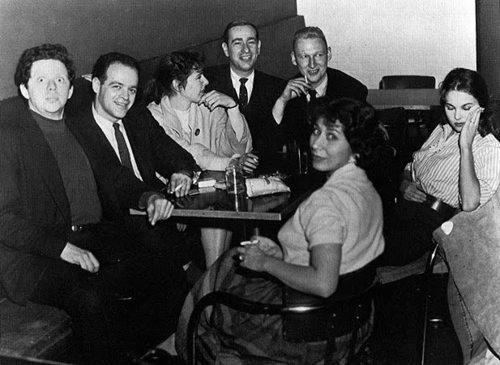
The Compass Players (1955), Severn Darden, Larry Arrick, Elaine May, Shelley Berman, Mike Nichols, Rose Arrick, Barbara Harris.

Our Living Newspaper came before our scenario play, which came before audience suggestions. The Living Newspaper was short, pithy, conceptual, sarcastic, surprising.

What were some components?

    Shelley Berman did an advertisement for treasure diving. He pantomimed swimming underwater while reciting the ad in a froggy voice. The pretense of discovering doubloons under one's local pond was ridiculous. 

    Mike Nichols flopped his bony arm over a louvre and read New Yorker copy for a million dollar Tiffany bracelet.


    Two commentators (Mike Nichols and Andrew Duncan) describe each round of a boxing match in the style of Sports Illustrated and then the Ring. The fighters appeared alternately as brutes and carefully trained strategists.

    Andrew Duncan measured Barbara Harris' dress in the salon of Christian Dior - miming a photo from the Daily News. I played Dior and read the article in the style of story theatre, speaking of myself in the third person.


In all these scenes we pretended to know exactly what the point was and why we were making it. We assumed that the audience knew what we were saying, and most of the time they did. The university produced thousands of smart, curious people who didn't happen to want to get up on stage. Some frequent flyers did get back stage to join the company and take short roles.

As for a political tinge, Second City was more overt than we were. In fact several people in COMPASS objected to political slants, and when I got them to do a scenario about the Black List in radio, it lacked COMPASS joy.

However, LIVING NEWSPAPER COULD NOT BE ACCUSED OF DISTORTION because the very words of the periodicals were there in print in our hands as we played.

TODAY 2002, most news is on TV. Players satirize weathermen. A good visual is the TV spot - shot at home or in the office. War scenes and home disasters can be adapted for stage performance. A few sound effects on audio tape will make these locations seem more real.

 
Michael Golding is an improv teacher, writer and director who participated in the evolution of the Improv Olympics, the Canadian Improv Games, and created the Insight Theatre Company for Planned Parenthood, Ottawa. He is currently a faculty member at Compton College working with at-risk teens and traditional students. Michael was the artistic director of the Comic Strip Improv Group in New York City and co-produced and wrote the documentary "David Shepherd: A Lifetime of Improvisational Theatre." His book, "Listen Harder," a collection of essays, curriculum and memorabilia on improvisation and educational theatre is available on Amazon.   


Friday, February 14, 2020

MEET THE REAL VALENTINE BY DAVID SHEPHERD

David Shepherd, the visionary behind Compass (forerunner of Second City), Improv Olympics and Canadian Improv Games, celebrated Valentine's Day in 2004 by improvising a scenario with an invited group in Hadley, MA,  based on the real story of St. Valentine; the struggle for individuality against the interests of the Empire. David explored other "holy days" through his nonprofit organization Group Creativity Projects, which enabled groups to create their own movies, plays, novels, poetry and radio shows through improvisation. The following is from his invitation.

MEET THE REAL VALENTINE BY DAVID SHEPHERD

For thirty years, Group Creativity Projects has celebrated Interactivity with actors, comedians and filmmakers. This weekend we enter the 21st century by visiting Valentine's Day to discover the questions, and our talents, answer to an important question: Who was Valentine? 

David Shepherd's invitation for 2004 shoot

Over the years, Valentine's Day has become a day to express your affection for people by giving them gifts, cards and candlelit dinners. As a result, card companies, gift factories and restaurants make a lot of money on Valentine's Day. To ensure that the money keeps rolling in, manufacturers have produced a veritable Valentine's Day assembly-kit: roses, chocolate, red hearts, white lace and a card saying "I love you." Doesn't it seem strange that a unique love, between unique people, is celebrated formulaically? 

As it turns out, the original Valentine was not a romantic message, and it was not flurried with lace and hearts. It comes at the end of an old story with a surprisingly contemporary theme: the struggle for Individuality against the interests of Empire. 

Like all ancient history, the story of Valentine grew from an amalgam of whispers, facts, theories and crosshatchings. In this sense, St. Valentine was and is a product of group improvisation.

2004 invitation
  
Legends abound about a mysteriously romantic St. Valentine who wed lovelorn couples during the reign of Claudius II in the third century A.D. The emperor had outlawed marriages to increase numbers in his army, and the sympathetic priest married couples in secrecy.

In reality, there are three St. Valentines on record. The first was  priest in Rome who assisted martyrs who were persecuted under Claudius II. He was beheaded in 270 because he wouldn't renounce his faith. The second St. Valentine was a bishop of Interamna (now Terni, located about 60 miles from Rome) who was also martyred under the reign of Claudius II. The third bearer of the name suffered martyrdom in Africa along with some companions - but nothing further is known of this saint.   

Cast and crew for 2004 shoot.

David Shepherd - Feb. 14, 2018

Michael Golding is a writer, director and improv teacher.  He can be contacted for workshops, festivals and private consultations at migaluch@yahoo.com. Michael participated in the evolution of the Improv Olympics & Canadian Improv Games. Artistic director of the Comic Strip Improv Group in N.Y. & created the Insight Theatre Company for Planned Parenthood, Ottawa.  He is a faculty member at El Camino College in Los Angeles, working with at-risk teens and traditional students. He wrote and co-produced the documentary "David Shepherd: A Lifetime of Improvisational Theatre" (available for free on YouTube).  His book, Listen Harder, a collection of essays, curriculum and memorabilia on improvisation and educational theatre, is available on Amazon, Barnes & Noble and CreateSpace. Michael holds a BFA degree in Drama from New York University’s Tisch School of the Arts & an MA degree in Educational Theatre from NYU’s Steinhardt School of Culture, Education & Human Development.   

Wednesday, March 20, 2019

David Shepherd's Journals by Michael Golding


David Shepherd (October 10, 1924 – December 17, 2018) the co-founder of Playwrights Theatre Club, Compass (forerunner of Second City), the Improv Olympics and Canadian Improv Games, left behind a library of personal journals. David was diligent about making daily entries, a practice he started at thirteen, inspired by his father William Edgar Shepherd, an architect, and continued into his nineties. The journals are replete with designs for new forms of theatre and outlines for potential books. I am including two brief excerpts.  David’s journals, along with his archives, were donated to Northwestern University’s Charles Deering McCormick Library of Special Collections in 2016 and are currently being processed. 

MANIFESTO
BLUEPRINT FOR THE NEW FREE THEATRE (NFT)
Paris 1949 

The NFT should be small at first. The connection between actor and audience has been lost in the coy hypocrisy of the realistic theatre but can be found again by testing effects at close range. To counteract the sloppy diffusion of the modern sensibility, the NFT will be, if nothing else, vigorous and disciplined. Discipline is necessary both for conciseness and for style. In modern acting efficiency is lost in movement and speech; both are diffuse and meaningless since both copy natural life, which is almost always diffuse and meaningless. 
A play cannot be a novel because a play has only an hour or two to make its mark. The single exception in this rule is Chekhov. Great craftsmen of today (Picasso, Rouault, Pound, Thomas, Stravinsky, Hindemith) either set out to work in any style or else limit themselves severely to one. Great drama is not written today because playwrights have cut themselves not only from the roots of drama but also from the understanding use of styles.  We need both eclectic genius and the craftsman with a single tool and single sheet of metal.
The vigorous roots of drama are song and dance, which must be brought back, if not outright, then in precise and suggestive speech and movement.
Since a play is the most clearly social of all art forms, the NFT must assure directness and simplicity in its productions. Whatever conventions it adopts must be quickly understandable.

Journal entry

MANIFESTO – SYNOPSIS OF INTRO TO BOOK
August 1952

The first purpose of this book is to advertise a theatre movement.
We are working to build a body of good American plays on the assumption that a great play has yet to come out of America, that the theatre of the future will be the “popular” theatre, and that we have discovered some of the ways of writing better plays than the current crop offers. We need partners to help us.

David Shepherd

We believe the easiest way to get the good plays we need is by attending to style; you will find exercises in this book which show what we mean by style. We believe that plays can be written on any subject, in any style and to any length: in this book you will find copies of the styles of some major dramatists today. In other words, we believe plays are logical statements, not bursts of inspiration.

Just as style is an exploitation of the word, so the choice of the action or subject matter of a play is an exploitation of the world of the dramatist. We deplore the fact that whereas the world of the dramatist today is so broad, his plays are so narrow. We give reasons in this book for such a paradox, and we explain what our second problem is after style: to broaden the frame and focus the thought of our plays. We suggest some dramatic forms by which that can be done, although we doubt that bourgeois writers will want to use them.

Journal entry


Michael Golding is a writer, director and improv teacher.  He can be contacted for workshops, festivals and private consultations at migaluch@yahoo.com. Michael participated in the evolution of the Improv Olympics & Canadian Improv Games. Artistic director of the Comic Strip Improv Group in N.Y. & created the Insight Theatre Company for Planned Parenthood, Ottawa.  He is a faculty member at El Camino College in Los Angeles, working with at-risk teens and traditional students. He wrote and co-produced the documentary "David Shepherd: A Lifetime of Improvisational Theatre" (available for free on YouTube).  His book, Listen Harder, a collection of essays, curriculum and memorabilia on improvisation and educational theatre, is available on Amazon, Barnes & Noble and CreateSpace. Michael holds a BFA degree in Drama from New York University’s Tisch School of the Arts & an MA degree in Educational Theatre from NYU’s Steinhardt School of Culture, Education & Human Development.   


Sunday, February 3, 2019

David Shepherd and the ImprovBoston Festival by Michael Golding


My close friend and mentor for 46 years, David Shepherd, the father of improvisation, passed away on December 17, 2018. He was 94 years old. With Paul Sills, David created Compass (1955), the first professional improv cabaret in North America and forerunner of Second City (1959). With Howard Jerome, David created the Improv Olympics (1972) which inspired the Canadian Improv Games (1977, created by Howard Jerome and Willie Wyllie) and i.O. (1981, founded by Charna Halpern and Del Close). In 1998, David brought MOVIExperience, his improvising movies with nonprofessionals format to Pioneer Valley, Massachusetts. Nancy Fletcher, one of the MOVIExperience participants, believed the format could be used to build confidence and character in adolescent girls and founded Act Now! (2000). David's last format was Life-Play (2009), improv games designed to be played over the phone. 
David Shepherd & Michael Golding
David Shepherd suffered from manic depression most of his adult life. His wild mood swings were at times terrifying for me in my early teens. Paul Sills had a gift for being able to diffuse David’s temper and I’d like to think that I learned from the best. I felt the two were polar opposites when it came to temperament, which is why I was surprised to learn in Jeffrey Sweet’s “Something Wonderful Right Away” that Paul had a formidable temper of his own. I remember thinking “I know not this Paul Sills people are talking about.” Paul was always warm, funny and supportive in the workshops I took with him. He never threw a chair at me (not even an imaginary one), which was a recurring memory from the founding members of Playwrights Theatre Club, Compass and Second City.       

Through David’s association with ImprovBoston, we had arranged for his documentary “David Shepherd: A Lifetime of Improvisational Theatre” to be screened at their annual festival in 2011. It would include a Q & A session with me, David, Howard Jerome and Nancy Fletcher and a workshop demonstration of Life-Play, David’s latest format.  I agreed to fly to Belchertown from Los Angeles so that I could drive with David and Nancy to the event.

When I arrived in Belchertown, David surprised me with the news that he planned on showing an instructional Life-Play video after the screening, aiming towards selling copies to the audience. I told him that was not the agreement with the festival and Life-Play was already represented quite well in the documentary.  David was not pleased with that answer and wanted me to approach the festival about changing the program.

By nightfall Howard arrived from Toronto. I had heard back from the festival. We were going to stick to the original plan. David was incensed, ranting about how hard he worked on the videos. Willie Wyllie, the executive producer of the documentary called David from Ottawa (responding to my S.O.S. text) hoping to reason with him. The work on the videos wasn’t wasted. He just couldn’t show or sell them at the screening. The focus was on the documentary and the fine work of our director, Mike Fly and writer, (me). David had an enormous amount of respect for Willie, who could always be counted on to give the final word he would accept. Willie was successful once again.

Howard and I agreed to look at the video so that David could get our feedback. It was dreadful. Poorly lit, bad editing and hard to follow. Not the best representation of David’s work and we told him that. His cork popped; “Fuck it! I’m getting too old for this shit! I can’t do this anymore, schlepping from place to place trying to get gigs and selling my formats!”  Of course, none of this was the case with the festival, where he was to be honored.  Maybe he couldn’t accept that even though the documentary was about him, it wasn’t his project and he needed to focus on something where he had some control. To David, the documentary represented the past, Life-Play, the present and future. So that evening the three of us in an instant went from a loving reunion to a lot of yelling and “fuck you!”

Next morning, I greeted David with my usual “Good morning, Mr. Shepherd. How are we today?” David somberly replied, “I can’t wait for this day to be over.” I laughed; “Atta boy. That’s the spirit.” My approach whenever David was in the dark zone was to treat his every response with optimism, love and humor.  Howard was already on his way to Boston to catch some shows before our screening.

Once we were in the car and on the road, (me at the wheel, David in the passenger seat and Nancy in the back), he relaxed considerably. Road trips were a big part of our relationship and we seamlessly eased into our travel banter – improv, expanding Life-Play, future projects, my work with at-risk populations. We picked up lunch from MacDonald’s on the way, and David slowly fed me French fries one at a time as I drove.  I loved that. When we arrived in Boston, David was wide-eyed. It had been a while since he’s been there and was fascinated by the architecture and people. By the time we arrived at the theatre, David was in a playful, joyful mood.

Well, that quickly ended as the audience entered for the screening. The event wasn’t well publicized and there were about 25 people in the audience. David glared at me and I could see that he was ready to determine that the screening was going to be a humiliating failure for him.  Just then, a young woman sitting behind David started talking about how excited she was to see the documentary. She had driven with friends from Rhode Island, was currently reading The Compass by Janet Coleman (who was also in the documentary) and was hoping that she could get to meet David Shepherd.  I turned around and said, “Are you aware that the father of improvisation is sitting right in front of you?” She exploded with excitement. A sly smile appeared on David’s face as she showered him with appreciation. After they talked a bit, David turned around and the house lights started to dim. I leaned over to David and whispered, “that didn’t suck, did it?”  “No. It did not.” He patted my knee affectionately.

This was the third time I had watched the documentary from start to finish with David and he’s always totally engrossed. I could only imagine what memories sparked inside him with every viewing.  The audience while small, was extremely responsive.  As the end credits rolled, David whispered, “that was excellent.” His standard response, always with a tinge of amazement in it.  I was happy to see Carman Dewees at the screening. He, along with Chris Britt, developed Life-Play with David. Carman and David had a falling out due to David’s unreasonable demands (a constant with partners David has collaborated with over the years) and had not spoken for some time.  David was sincerely pleased to see Carman and the two had a warm, brief reconciliation.  After they spoke, David confided in me that he accepted full responsibility for Carman leaving Life-Play. Carman was solely responsible for the launch and initial success of Life-Play, recruiting players, setting up conference calls and putting together a polished handbook of the format’s games with essays from me, David, Howard and himself. David realized he had let a gem slip through his fingers.

The Q & A portion went well, as did the Life-Play demonstration, which I conducted with volunteers from the audience. David and Howard side-coached some of the games. Originally scheduled for ten minutes, I ended up doing a half hour because it was going so well. Jeremiah Jordan, the artistic director of the festival who was watching from the side gave me the okay. When it was over, we had to quickly leave the theatre for the next event to set up. The audience followed us out into the lobby, enveloping David with attention, then outside the theatre, then joined us for dinner at a restaurant down the block.  David was energized, talking improv and meeting new people. 
Q&A moderated by Jeremiah Jordan with Michael Golding, Nancy Fletcher, David Shepherd and Howard Jerome.


Setting up Life-Play guidelines with two volunteers.

David Shepherd and Howard Jerome side-coach two volunteers playing a Life-Play game.

Driving home, I fielded calls from Mike Fly and Willie Wyllie.  It was a ninety-minute drive and I was pushing the speed a bit. With David holding the phone to my ear and Willie draining me for every detail, I tell my improv brother that “the life of the father of improvisation is in my hands right now so maybe I should focus on my driving.” For the rest of the drive, we talked about all the new people we met at the screening and how David was going to recruit them for future projects. He had given out all his business cards. He was happy.   

Back at the house, Nancy goes immediately to bed and David and I stay up for a while, sharing a joint. Yes, I was smoking with an 87-year old man. It was a long active day. Navigating David’s emotional minefields can be draining, but now I was getting stoned, playful, fun, David. It made the day worthwhile for me.

After we say our goodnights I walk towards my room. David sings out “Michael!”

“Yes, David?”

“You’re an excellent workshop director.”

“Thank you, David. I had a great teacher.”

“Thank you.”

For a moment I thought about screwing around with him by adding “Oh, you thought I meant you?” But it would have ruined a perfect moment. And it would have been a lie.

Next morning David wanted to know when we were going on our next road trip.

David Shepherd, Michael Golding, Howard Jerome and Nancy Fletcher at ImprovBoston, 2011.

Michael Golding is a writer, director and improv teacher. He can be contacted for workshops, festivals and private consultations at migaluch@yahoo.com.  Michael participated in the evolution of the Improv Olympics and Canadian Improv Games. Artistic director of the Comic Strip Improv Group in N.Y. and created the Insight Theatre Company for Planned Parenthood, Ottawa. He is a faculty member at El Camino College in Los Angeles, working with at-risk teens and traditional students. He wrote and co-produced the documentary "David Shepherd: A Lifetime of Improvisational Theatre" (available for free on YouTube). His book, "Listen Harder," a collection of essays, curriculum and memorabilia on improvisation and educational theatre is available on Amazon, Barnes & Noble and CreateSpace. Michael holds a BFA degree in Drama from New York University's Tisch School of the Arts and an MA degree in Educational Theatre from NYU's Steinhardt School of Culture, Education and Human Development.   


Wednesday, May 10, 2017

From the Archives: David Shepherd’s Improvisational Theatre Notes


I was in Ottawa recently for the 40th anniversary of the Canadian Improv Games (CIG), a nation wide program for high school students who perform improvised scenes in teams based on suggestions from the audience. During the school year, teams participate in regional tournaments. The winning team from each region then goes on to the National Festival and Tournament held in Ottawa in April at the National Arts Centre. CIG was created by Willie Wyllie and Howard Jerome, inspired by the Improv Olympics, created by David Shepherd and Howard Jerome. Along with Paul Sills, David Shepherd was the producer of North America's first professional improvisational theatre The Compass, which was the forerunner of the Second City.


A week before the National Festival this year, I spent a few days at the home of Howard Jerome in Hamilton, so that we could attend a CIG fundraiser together in Toronto. While I was at Howard’s home, I dug through his improv archives to see if there was any material I could add to David Shepherd’s collection, which is now housed at Northwestern University. Most of the material I came upon was from the Improv Olympics, including the Spring 1976 issue of Nous Journal, a local Ottawa newspaper. Howard Jerome and David Shepherd were in town at the time to conduct Improv Olympic workshops at various high schools and Howard convinced the editors to devote their Spring issue to improvisation.


The issue includes descriptions of the Improv Olympic events (Time Dash, Emotional Hurdles, Character Relay, Space Jump, Silent Wrestling, Sound Swim), warm-up games and educational tips. What I found particularly fascinating about the issue, which I am sharing, is an essay written by David Shepherd which serves as both a history lesson and the foundation of his philosophy about why we should all be improvising every day – (which we do whether we’re aware of it or not). Enjoy.


Improvisational Theatre Notes
By David Shepherd


Improvisation is one of the oldest kinds of theatre. Five hundred years ago families of Italian Players made their living going from town to town doing “Commedia.”  This was a live soap opera – all improvised in parks, streets and festivals. If the players managed to keep their characters interesting, then the public would come back day after day. When people stopped paying, the troupe moved on.

Each players studied a couple of handbooks about his character – one full of speeches he could use, the other full of “bits” he could do. These books were handed on from mother to daughter (or father to son) as young people in the family got old enough to play the standard parts of Doctor, Captain, Servant, etc.  In his youth, Moliere played in a similar group.

As soon as the troupe arrived in a town its members would collect as much local gossip as possible about the people they’d be playing for. Each show was based on a situation invented for that audience. If after a few minutes this idea led nowhere, the players simply stopped. With no embarrassment they said to the audience: “Sorry. Our improvisations didn’t work. Let’s try again.” They huddled, invented a new situation, and stared all over.

When a player got in trouble he fell back on what he’s learned from one of the two books. The Captain, for instance, might start telling the audience how he was about to die! …. For the love of a farm girl. Arlechino the servant might mime a fly buzzing around his head. He’d track down that imaginary fly until he caught it in his cupped hand and then – ate it!

Improvisational theatre exists today in Toronto, where the Second City Troupe knows how to take a suggestion from the audience for an improvisation about our Canadian life. They also do a show based entirely on scenes that were first improvised, then memorized and set.  

Improvisation works best among people who know and can trust each other. It does not work on conflict. We have to cooperate in many ways in order to play:

We must agree on where we are (for instance, if I decide that a giant safe is against this wall, then you can’t walk through that space).

We must agree on who we are (for instance, if you say you’re my mother, then I have to accept you as my mother).

We must agree on what we’re doing together.

In improvisational theatre there is no need for a painted set.  Nor do you need a script. You don’t have to have thousands of watts of stage lighting. You don’t even need a stage. And in fact, improvisational theatre works better if you don’t have stage, lights, set and curtain. Because without these limitations, you have the freedom to explore.

In this issue of NOUS JOURNAL, you’ll see how to do three things:

1.     experience the freedom and fun of improvisation (this takes only a few minutes.)
2.     use improvisation to write a group scene that’s half prepared, half improvised (this takes an hour)
3.     use improvisation to put on a show for yourselves or for the class next door (this takes two hours)

Remember: there’s nothing new or strange about improvisation. You’ve been doing it all your life:

For instance, if you’ve ever pretended you were angrier than you really were – or sadder, or happier – just for the fun of it…..

If you ever pretended you were a hockey star or a finicky grandmother or a down-and-out bum (with no script to tell you what to say)……

If you ever imagined (with a friend) that you were in some jungle hideaway or rocket ship or fancy party….

If so, you were improvising. It’s natural to play a feeling, character or place that you don’t usually experience. It’s healthy to relax once in a while, let your hair down and your feelings out. Live without concentrating on being yourself. Enjoy stepping into another’s shoes, onto another planet, under another feeling. 


Michael Golding is a writer, director and improv teacher.  He can be contacted for workshops, festivals and private consultations at migaluch@yahoo.com. Michael participated in the evolution of the Improv Olympics & Canadian Improv Games. Artistic director of the Comic Strip Improv Group in N.Y. & created the Insight Theatre Company for Planned Parenthood, Ottawa.  He is a faculty member at El Camino College in Los Angeles, working with at-risk teens and traditional students. He wrote and co-produced the documentary "David Shepherd: A Lifetime of Improvisational Theatre" (available for free on YouTube).  His book, Listen Harder, a collection of essays, curriculum and memorabilia on improvisation and educational theatre, is available on Amazon, Barnes & Noble and CreateSpace. Michael holds a BFA degree in Drama from New York University’s Tisch School of the Arts & an MA degree in Educational Theatre from NYU’s Steinhardt School of Culture, Education & Human Development. 


Tuesday, October 1, 2013

The Improv Archives by Michael Golding


Somehow, I’ve become the improv archivist.   Always had a healthy stash of vintage memorabilia, as a result of my friendship with David Shepherd.  The basement of his country house in Armonk, New York, was a shrine to Compass; posters, flyers, scenario plays, press articles and pictures, neatly preserved in albums and file folders.  Unfortunately, a flood in the early 1980s took out nearly a third of his collection, including some reel-to-reel recordings of Compass.

  
Shortly after the 2009 Canadian Improv Games National Festival (inspired by David’s Improv Olympics), Willie Wyllie, co-founder of the format, recruited me and Mike Fly, an improviser and filmmaker from Toronto (Sexy Nerd Girl, Versus Valerie and Space Janitors) to shoot a series of interviews with David on his fifty-plus year career in improv.  Originally intended as a web series, Mike Fly had a vision that resulted in us making a full-length documentary, much to the chagrin of Willie, who was financing the project.  I don’t think I’ve ever worked with a director who was more confident, versatile and innovative than Mike, which is why I was surprised when he confessed one night that this was his first feature-length project.

Mike Fly and I spent four days filming David at his home in Belchertown, Massachusetts.  When it came time to get digital shots of his pictures, I was shocked when David came out of his office with a box, and dumped the contents onto the floor.   Gone were the days of his meticulous file keeping system. Mike set up the borders for the pictures, and one by one I handed him a photo to be digitized.  This process took us close to two hours - six, if Mike didn’t stop me from commenting on every shot (“Holy shit! Do you know what this is? It’s the holy grail of improv pictures!”).

Compass cast: Severn Darden, Larry Arrick, Elaine May, Shelley Berman, Mike Nichols, Rose Arrick & Barbara Harris - 1955.
Back home in Los Angeles, I plowed through the pictures on my laptop that Mike emailed me from Toronto.  We categorized them into files (Playwrights Theatre Club, Compass, Second City, Improv Olympics, etc.).  The largest was our miscellaneous file - great shots, but not relevant for the documentary. 

Little known Shepherd format.  Unfortunately, not enough material to cover in documentary. 

Despite the vast collection David gave us, there were still gaps in the timeline.  We managed to fill some of those in with pictures from the archive department at the University of Chicago.  David had donated a great deal of his memorabilia to the university.  I procured several discs from the department, which included a healthy selection of shots from the early days of Second City.  Again, many were not relevant for the documentary, but still spectacular in terms of improv history.  Those found a special home in my laptop.

Robert Klein & Fred Willard, Second City 1965
I started scouring the internet for pictures I knew existed, but weren’t in David’s or the University of Chicago’s collection.  Image search from Google and Bing were helpful, but the biggest finds came from magazine and newspaper articles from the late 1950s and early 1960s.  Maybe one or two found their way into the documentary.  Others, yep, express lane into my laptop.

Paul Sand, Severn Darden & Melinda Dillon in an ad selling advertising to liquor companies.

Shortly after we made the documentary available on YouTube, I realized that the hundreds of pictures nestling in my laptop weren’t doing anyone any good by remaining there.  So, I decided to share them with the improv community, mostly through various Facebook improv pages.  The response was immediate, unexpected and gratifying.

Alan Arkin, Paul Sills and Anthony Holland at Second City, 1961
First person I heard from was Aretha Sills, who told me that her father Paul was not great at holding onto things from the early days.  So, it was a pleasure to send her shots from Playwrights Theatre Club and Compass.  Sheldon Patinkin, with his incredible memory, was able to recall touching, personal anecdotes that provided a wonderful background to the pictures I was posting on a Chicago Theatre site.  A group picture from Jo Forsberg’s Player’s Workshop evoked a warm memory from George Wendt about an improviser he was enamored with. 

George Wendt in Jo Forsberg's Player's workshop - 1973
When Bernie Sahlins passed away earlier in the year, I realized that I had a picture of him from my miscellaneous file in front of Second City on their opening night in 1959.  That became the most re-posted photo from my collection on Facebook.
Bernie Sahlins

Soon, people were coming to me with requests.  Charna Halpern was moving i.O. to a different location in Chicago. Did I have any unique shots of Del Close? Yes, I do. 
 
Joan Rivers & Del Close at Second City, 1961.


The curator of the Viola Spolin library exhibit at Northwestern University inquired if I was willing to clarify some photos and documents?  More than happy to.  A director from Second City in Chicago contacts me about submitting pictures for their upcoming celebration of the Playwrights Theatre Club. Done.  There is a Compass Improv Festival in St. Louis, Missouri.  Do I have shots from the original St. Louis Compass?  Sure do.

Playwrights Theatre Club brochure - 1953.
 

Jerry Stiller, Nancy Ponder & Alan Arkin at the St. Louis Compass, 1959.

These days, I’m trying to convince David Shepherd that a book of his vintage shots would be of enormous interest to the improv community.  Aside from the documentary, many have appeared in Jeffery Sweet’s Something Wonderful Right Away and Janet Coleman’s The Compass.  But believe me my improv brothers and sisters, there are scores of other pictures that have not been viewed by the public for many decades.  It’s time they found their way back into the light.


Michael Golding is a writer, director and improv teacher.  He can be contacted for workshops, festivals and private consultations at migaluch@yahoo.com. Michael participated in the evolution of the Improv Olympics & Canadian Improv Games. Artistic director of the Comic Strip Improv Group in New York & created the Insight Theatre Company for Planned Parenthood, Ottawa.  He is a faculty member at El Camino College in Los Angeles, working with at-risk teens and traditional students. His screenplay credits include "Celebrity Pet" for the Disney Channel and the documentary "David Shepherd: A Lifetime of Improvisational Theatre."  His book, Listen Harder, a collection of essays, curriculum and memorabilia on improvisation and educational theatre, is available on Amazon, Barnes & Noble and CreateSpace. Michael holds a BFA degree in Drama from New York University’s Tisch School of the Arts & an MA degree in Educational Theatre from NYU’s Steinhardt School of Culture, Education & Human Development.


Thursday, July 11, 2013

Fool's Paradise by Michael Golding


Apparently, most fourteen year old boys are into sports.  I had an improv group.

In the Fall of 1972, The Responsive Scene, an improvised radio show produced by David Shepherd, (co-creator of Compass, the predecessor of Second City) ended its run.  Responsive Scene involved the listening audience, who called in with scene suggestions for the studio actors to improvise.  Being a regular caller to the show, I was devastated.  For three months it had been a weekly outlet where I was allowed to be a performer, writer and director.  Now it was over.

From a WRVR-FM press release
 
Responsive Scene Radio Show. Left to right; Penny Kurtz, David Shepherd, Howard Jerome & Lynn Bernfield
Then, I got a call from David Shepherd.

David and Howard Jerome, the host and one of the performers from Responsive Scene, had developed a new format called the Improv Olympics, which they were about to unveil.  David wanted me and my friends to participate.  The format was a “performance sport” where teams of actors improvised scenes competitively.
 
1972 Improv Olympic playbill.


Winning team congratulate themselves.
 
Within a few months, I formed my first improv group – Fool’s Paradise – a moniker Shepherd hated (“It sounds like you’re mocking yourselves!”). We competed every week at the Space for Innovative Development in Manhattan, the first home for the Improv Olympics. The highpoint came when we started beating the adult players.

Fool's Paradise improvising at the Space for Innovative Development.


Fool's Paradise beats David Shepherd's team.

There were two versions of Fool’s Paradise.  In junior high, it was me, David Hasson, his sister Robyn, and Eddie Ben-Menachem.  The second, in high school was me, Steven Blance, Mark Traub, Bruce Herman, Heidi Adelman, Debbie Triolo, Sheree Givre, Martha Orellana, David Oberon and Eric Mortensen.  There were also friends who attended workshops or participated in a one time project; Seth Newman, Robert Socolof, Susan Israel.

Fool's Paradise - Bottom left to right; Mark Traub, Michael Golding. Middle; Sheree Givre, Martha Orellana, Debbie Triolo. Top; Bruce Herman, Steven Blance, David Oberon.

From 1972 through 1976, “Fool’s Paradise” continued playing in the Olympics at the Space for Innovative Development.  Alumni from Compass and Second City would frequently come down to the Olympics to be guest stars and I was fortunate enough to watch and sometimes play with Barbara Harris, Andrew Duncan and Marty Friedberg.


Improv Olympic directing suggestions.

Improv Olympic Player's Contract.

Fool’s Paradise had a separate life away from the Space for Innovative Development.  Rehearsals usually took place in the basement of my home, where we played a variety of Spolin games to keep ourselves sharp – or mini Improv Olympic matches.  Then we started having “improv theme parties.”  First, we started with roasts.  Each month, a member of Fool’s Paradise would be chosen as the man/woman of the hour.  Then we moved on to a talk show format, set in the future, where all of us would be famous and in our thirties.

Fool's Paradise for hire.

We had an improv club in high school, composed entirely of Fool’s Paradise members.  Our company played at assemblies and parties.  Our greatest achievement was a ninety minute show at the West End YMCA in Manhattan, which was a combination of games and scenes developed through improvisation. There was also an homage to Nichols and May, where we reenacted the telephone operator scene.   As was the case with the Improv Olympics, a section of our show involved improvising with members of the audience.

West End YMCA show. Heide Adelman & Eric Mortensen as over-anxious shoe salespersons, with the author as customer.

West End YMCA show. Fool's Paradise watches cautiously as two audience members improvise.

West End YMCA show.  Fool's Paradise member Bruce Herman (left) improvises with audience member.


West End YMCA show. Mark Traub & Heidi Adelman reenact Nichols & May telephone operator scene.
 
David and I developed a mentor/protégé relationship, resulting in spending time at his home in Greenwich Village.  One summer, several of us spent a weekend at David’s country house in Armonk, experimenting with improvising video movies.  Our parents were either very trusting or naïve.  It was one thing for us to hop a subway in Queens to go into Manhattan and play theatre games with some old hippies.  Now, a bunch of us were going away for a few days with this guy who wasn’t a family member.

Experimenting improvising movies.
 
As a result of our experiments with video, David loaned me his equipment so we could make a Fool’s Paradise movie.  Seth Newman, a friend who was not a member of my troupe, had an idea for a movie about a man obsessed by the Kennedy assassination to the point where it interfered with his life.  Together, we outlined the beats for the story, Seth took the directing helm, and the rest of us took on serious acting roles.  The end result, “Forgotten Memories,” a tight sixty minute movie that impressed David no end, since he frequently viewed us as teenage jokesters.

By the time we graduated high school, Fool’s Paradise was over.  Several of the core group went out of state for college.  Steven Blance and I frequently joked about a Fool’s Paradise reunion.  Unexpectedly, during my senior year at New York University, it happened.

Mark Traub, who was also attending New York University, had a video project to shoot – a game show parody called “Beat The Punch.”  He recruited me, Steven Blance, Bruce Herman, and Robert Socolof for the cast.  When we got together in the studio, Mark presented us with his idea, but there was nothing on paper.  At first I thought “this isn’t like Mark to be unprepared,” then realized Mark choose the right people.  Within minutes, we hammered out an outline, established the beats, improvised a few ideas, and then shot the concept.   “Beat The Punch” involved a host giving two contestants the opening line of a joke (“How do you make a gypsy omelet?) and one has to yell out the punch line first (“Steal two eggs!”)

Steven was the host; Robert and I were the contestants.  We decided to use the game “One Second Behind” where one player says exactly what the other has said; one second afterwards (like an echo).  Robert gave the correct punch line first, followed by me giving the same exact punch a second later, behaving as if I came up with it first.  We kept cracking up and had to reshoot the sequence several times.

At a diner after the shoot, I told Steven that we finally had the Fool’s Paradise reunion we always fantasized about.  Steven replied, “It was also our final performance.”

Well, yes – and no.

A little over twenty-five years later, I was conducting a private workshop in North Hollywood.  I had recently reconnected with Martha Orellana on Facebook, discovering that we both lived in Los Angeles.  Martha showed up at the workshop, where we played Emotional Hurdles, one of the events from the Improv Olympics.  In many ways, it was a surreal experience – but it filled us both with joy.

When my father passed away last year, the first few friends who reached out to me with condolences were members of Fool’s Paradise, several of them showed up at the funeral, wake and my family’s house.  One of my brothers noticed that when we interact with each other, we’re not merely talking.  We do characters, pantomime, sound effects.  It’s just second nature to us. It’s how we’ve always related to each other.

Some members of Fool’s Paradise look back on those years as an interesting period, which ended after high school because it was time to grow up.  But whenever I talk on the phone with one of my friends from that period, or get together in person, it’s like the “play switch” is suddenly turned on.

Personally, I don’t think it was ever turned off.  Hopefully, it never will be.

David Shepherd setting up a scene for Fool's Paradise member Mark Traub.


Michael Golding is a writer, director and improv teacher.  He can be contacted for workshops, festivals and private consultations at migaluch@yahoo.com. Michael participated in the evolution of the Improv Olympics & Canadian Improv Games.  Artistic director of the Comic Strip Improv Group in N.Y. & created the Insight Theatre Company for Planned Parenthood, Ottawa.  He is a faculty member at El Camino College in Los Angeles, working with at-risk teens and traditional students. Michael holds a BFA degree in Drama from New York University’s Tisch School of the Arts & an MA degree in Educational Theatre from NYU’s Steinhardt School of Culture, Education & Human Development.