Showing posts with label scenarios. Show all posts

Wednesday, January 20, 2021

COMPASS: The Living Newspaper by David Shepherd

 A constant in David Shepherd's improv career was periodically revisiting his groundbreaking format, COMPASS (a "people's theatre," co-created with Paul Sills in 1955) and attempting to update it with the collaboration of improvisers who were in his orbit at that time.

David continued conducting COMPASS workshops in New York, Los Angeles, Toronto, Ottawa, Boston, St. Louis and Chicago, well into his late eighties. These workshops focused on creating scenarios and rehearsing the Living Newspaper, the curtain raiser for COMPASS where newspaper and magazine articles were brought to life as players segued back and forth between narration, character dialogue, pantomime and tableau.

In 2002, David wrote this description of the Living Newspaper for Stephen Sim, the Artistic Director of the Winnipeg If....Improv Festival and co-founder of The Improv Company.

COMPASS: THE LIVING NEWSPAPER for Stephen Sim

The 1955 Chicago COMPASS was supposedly a sociopolitical statement in the environment of Senator Joe McCarthy. At that time, the University of Chicago had just passed through the leadership of a radical humanist - John Maynard Hutchins. And people were ready to drive great distances to hear what could be heard no place else. Nowadays expletives and derision (of this president or that premier) are not going to draw radicals and rebels to your theatre. So what do you do?

At COMPASS we set out to SHOW THE AUDIENCE WHAT IT WAS READING. "This is the Chicago Defender," we said. "This is its ethnic self image and this is its pretension to be unprejudiced." This is the Daily News, Chicago Tribune, Argosy, the New Yorker, The Ring, Sports Illustrated, Journal of Lifetime Living.
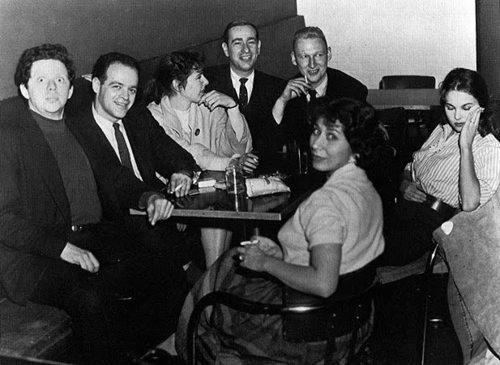
The Compass Players (1955), Severn Darden, Larry Arrick, Elaine May, Shelley Berman, Mike Nichols, Rose Arrick, Barbara Harris.

Our Living Newspaper came before our scenario play, which came before audience suggestions. The Living Newspaper was short, pithy, conceptual, sarcastic, surprising.

What were some components?

    Shelley Berman did an advertisement for treasure diving. He pantomimed swimming underwater while reciting the ad in a froggy voice. The pretense of discovering doubloons under one's local pond was ridiculous. 

    Mike Nichols flopped his bony arm over a louvre and read New Yorker copy for a million dollar Tiffany bracelet.


    Two commentators (Mike Nichols and Andrew Duncan) describe each round of a boxing match in the style of Sports Illustrated and then the Ring. The fighters appeared alternately as brutes and carefully trained strategists.

    Andrew Duncan measured Barbara Harris' dress in the salon of Christian Dior - miming a photo from the Daily News. I played Dior and read the article in the style of story theatre, speaking of myself in the third person.


In all these scenes we pretended to know exactly what the point was and why we were making it. We assumed that the audience knew what we were saying, and most of the time they did. The university produced thousands of smart, curious people who didn't happen to want to get up on stage. Some frequent flyers did get back stage to join the company and take short roles.

As for a political tinge, Second City was more overt than we were. In fact several people in COMPASS objected to political slants, and when I got them to do a scenario about the Black List in radio, it lacked COMPASS joy.

However, LIVING NEWSPAPER COULD NOT BE ACCUSED OF DISTORTION because the very words of the periodicals were there in print in our hands as we played.

TODAY 2002, most news is on TV. Players satirize weathermen. A good visual is the TV spot - shot at home or in the office. War scenes and home disasters can be adapted for stage performance. A few sound effects on audio tape will make these locations seem more real.

 
Michael Golding is an improv teacher, writer and director who participated in the evolution of the Improv Olympics, the Canadian Improv Games, and created the Insight Theatre Company for Planned Parenthood, Ottawa. He is currently a faculty member at Compton College working with at-risk teens and traditional students. Michael was the artistic director of the Comic Strip Improv Group in New York City and co-produced and wrote the documentary "David Shepherd: A Lifetime of Improvisational Theatre." His book, "Listen Harder," a collection of essays, curriculum and memorabilia on improvisation and educational theatre is available on Amazon.   


Monday, April 8, 2019

Teen Improv Fight Club by Michael Golding

It is not unusual for the at-risk teens I work with in workshops to be reluctant to embrace the unknown and allow an improvised scene to flow organically within the structure of a game. They require advance information with dialogue and action before participating, so they don't appear foolish. Directing focus on the rules of a format, which grounds players in the moment, eventually
weans the students off their perceived safety net. The current group I'm working with has provided a new challenge, leading me to formulate a new approach.

In the middle of a throng of students

With several decades of working with at-risk populations, I've become more flexible with how the rules of a structure are perceived and played. Being an improv martinet can be counterproductive in allowing the identity of the group to emerge. It's a fine line to walk; are rules being ignored because the players found an innovative way to achieve the objective - or they simply didn't listen to the guidelines and decided to do whatever they want?

At a recent workshop two players were given a scenario to improvise by the class (brother tells his sister that her boyfriend is cheating on her). The players immediately started strategizing on how it should be performed. Normally I would chime in with "No, don't plan it. All you need to know is who you are, what you're doing and where you are. That's it." Instead, I allowed them to strategize, because they were on fire collaborating and connecting with each other.

The students watching started contributing their suggestions on how to play the scene.  I almost put a stop to that - determining that it was up to the two players, not the audience to decide what to do. But the class was enthusiastic, the players liked some of their suggestions, built on them, so I allowed the process to continue.

As the scene commenced, the class proceed to side-coach, which I have encouraged in previous workshops with the guideline "say freeze, first. Wait for the action to stop, then add your direction." That wasn't happening this time. The class was overlapping, yelling out suggestions, sometimes debating amongst themselves over choices. None of this was contentious. The players would pause to consider options, occasionally asking questions for clarification, then move on. While the atmosphere became raucous there was a positive energy between the student audience and players working together to navigate the intricacies of a scene that was presented by the group. There were shifts in time, locations, emotions, activities and additional characters were added and removed. When the scene was over everyone felt they contributed to its success, and left the session feeling joyous and congratulatory towards each other.

Thinking about the session on my commute home, I felt that I had just witnessed a new guerrilla theatre/cage match approach to improvisation. Perhaps the birth of a new format; Teen Improv Fight Club. The first rule of Teen Improv Fight Club is: You don't talk about Teen Improv Fight Club.

Considering this current group, I have a feeling they would find a way to circumvent that rule.


Michael Golding is a writer, director and improv teacher. He can be contacted for workshops, festivals and private consultations at migaluch@yahoo.com. Michael participated in the evolution of the Improv Olympics and Canadian Improv Games. He was the artistic director of the Comic Strip Improv Group in New York and created the Insight Theatre Company for Planned Parenthood, Ottawa. Michael is a faculty member at El Camino College in Los Angeles working with at-risk teens and traditional college students. he co-wrote and produced the documentary "David Shepherd: A Lifetime of Improvisational Theatre" (available for free on YouTube). His book, Listen Harder, a collection of essays, curriculum and memorabilia on improvisation and educational theatre is available on Amazon, Barned and Noble and CreateSpace. Michael holds a BFA degree in Drama from New York University's Tisch School of the Arts and an MA degree in Educational Theatre from NYU's Steinhardt School of Culture, education and Human Development.


Wednesday, February 28, 2018

Guns, Education and Improv by Michael Golding


Due to budget cuts at high schools who normally host El Camino College’s after school outreach courses, I was not offered any assignments for the spring semester. This was not unexpected. Last fall, when Trump’s cuts to education began to take effect, my colleagues and I knew that it was just a matter of time before this impacted our program. I didn’t think it would happen so quickly.

The students I work with are at-risk. I teach Theatre Appreciation and Intro to Acting on a rotating semester basis. Students show up expecting a lecture course. Instead, they are exposed to my learning by doing approach. The objectives of the curriculum are achieved via theatre games and the class is conducted like an improv workshop.

My courses, which run from 3:30pm – 5:30pm (sometimes longer), keep the students out of trouble and from being targeted by gangs. It also instills the idea that college is a possibility for them.  Being exposed to a different approach in learning has a ripple effect on the students that enhances their academic and social skills. Attendance improves as well.

Now we don’t have the budget to keep this program going – on top of the recurring issue of no funds for supplies and resources in classrooms where enrollment hits 40 or more. This is not new for teachers. What is new is Trump’s proposal to arm teachers.


Here are my thoughts on that; I have been working with at-risk teen populations in Los Angeles since 2002. First through Los Angeles City College, then El Camino College (both the Torrance and Compton divisions). I have taught at high schools in Compton, Lynwood, Carson, Inglewood, Torrance and Hollywood. I have met and observed countless teachers doing their job extraordinarily well under the most daunting conditions.

I have also encountered a large number of teachers who do not have the temperament, patience, empathy, compassion or maturity to be working in education. Some are flat out sadists who enjoy the control they have over their students. I have witnessed this first hand. Believe me, a gun is the last thing you would want in their hands. If they could get away with shooting a student by claiming self defense, they would.

If I was teaching this semester, I would explore scenarios of a political environment that has armed teachers and how that would affect the classroom dynamic and relationships with students. A missed opportunity for me, to be sure.

A large percentage of my male students glorify guns. These students often want to improvise scenes about bank robberies, kidnappings, and hostage situations. Guns are brandished side-ways with a machismo that is simultaneously amusing and terrifying.

Occasionally, I’ll acquiesce to a scene about a bank robbery, with the guidelines of no shooting or pistol whipping.  Additionally, the guns have no bullets (or aren’t real). First time I tried that in a workshop with the guidelines one of the students playing a customer yelled out “hey, that gun isn’t real!” and I had to end the scene before it collapsed into a mass fight in the bank.  Now I instruct the students playing customers and tellers “You don’t know that the gun isn’t real or has no bullets.”  The emphasis is on the threat of the gun and power it wields – not seeing someone being shot.

I have a warm-up game where I play a series of sound effects and students have to engage in an activity that would correspond with it. The sound effects are typically bowling, ice skating, rain forest, traffic, beach, pool hall, which the students perform with varying degrees of commitment. When military battle sounds emanate from the speakers, the energy and commitment from the students spikes and there is disappointment from the class when after 30 seconds or so, the next sound effect pops up.

So, let’s review my perspective on inner city high schools in Los Angeles.

There is now no money for an after school program that keeps high school students out of trouble, enhances their academic and social skills and prepares them for college. A proposal has been made to arm teachers (some who carry resentment towards their students) around teenagers who glorify guns (and would figure out how to get the weapon from the teacher). Classes are still overcrowded.

What could possibly go wrong?


Michael Golding is a writer, director and improv teacher.  He can be contacted for workshops, festivals and private consultations at migaluch@yahoo.com. Michael participated in the evolution of the Improv Olympics & Canadian Improv Games. Artistic director of the Comic Strip Improv Group in N.Y. & created the Insight Theatre Company for Planned Parenthood, Ottawa.  He is a faculty member at El Camino College in Los Angeles, working with at-risk teens and traditional students. He wrote and co-produced the documentary "David Shepherd: A Lifetime of Improvisational Theatre" (available for free on YouTube).  His book, Listen Harder, a collection of essays, curriculum and memorabilia on improvisation and educational theatre, is available on Amazon, Barnes & Noble and CreateSpace. Michael holds a BFA degree in Drama from New York University’s Tisch School of the Arts & an MA degree in Educational Theatre from NYU’s Steinhardt School of Culture, Education & Human Development.   


Monday, June 2, 2014

David Shepherd's Strategies for Writing Scenarios


A recently discovered  item from David Shepherd's archives, written in 1982.   


A “scenario” is a sequence of events, such as “the scenario for the outbreak of war was different in 1914 from 1939.”

When we write a scenario, we’re creating a sequence of events for a group of players to play. To make real.

Reality in the scenario for World War I includes the assassination of an Arch Duke, Germany’s bid for colonies, etc. Conflicts in real Wheres.

Reality in a scenario we write must be different. Why?  Because on our stage there is no real Where. Only an imagined one.

So for us writing a scenario becomes making Wheres.  Because we can’t show what happens until we provide the context in which it’s happening.

Compass scenario play "Enterprise" (1955)

For instance, a husband and wife arguing becomes a totally different happening when set against different Wheres. If they’re arguing in a baby’s bedroom, it’s happening differently than it would in the bedroom of children who’ve left for college. If the argument takes place in a concentration camp, it’s not the same as an argument on Miami Beach.

How does the writer of scenarios define the Where?

By describing it’s color or shape?  No, because we have no set – except what the player can create through activities, physical response or emotional response.

Notice: words don’t count for much in creating a Where. We describe a Where better by interacting with it than by talking about it.

We can ask the players to interact with a Where by cleaning it, building it, using it, destroying it even, rather than describing it. In fact, we don’t sit around in real life describing our Wheres unless we are interior decorators.

Here are some guidelines for writing a scenario: 

Activity: cooking, playing cards, dancing, laying carpet……
Physical: it’s freezing, there’s a smell of soup cooking, it’s dark……
Emotional: they’re afraid of each other, they love the sun…..

Finally, tell us What Happens by the end of the improvisation.  In other words, tell us what goes into the improvisation at the top, and what comes out at the end.

Don’t tell us what happens in the middle.  Don’t give us a blow-by-blow account. Don’t give us a dozen Exits and Entrances. Don’t write dialogue. All of that is for the players to improvise.

To help the players understand the scenario in your head, make sure we understand the time sequence of the improvisations. For instance, one improv could take place “at midnight on the couple’s tenth anniversary.” Another might take place “two martini’s later” or “twenty years before.”

Think of your scenario as pieces snipped out of time, out of the fabric of our lives together.  It takes only 3-10 such pieces to tell a story.

Remember: Just as a poem or story, your scenario will probably have to be rewritten several times before it expresses your deepest and most dramatic insights.

Scenario sample by David Shepherd


Michael Golding is a writer, director and improv teacher.  He can be contacted for workshops, festivals and private consultations at migaluch@yahoo.com. Michael participated in the evolution of the Improv Olympics & Canadian Improv Games.  Artistic director of the Comic Strip Improv Group in N.Y. & created the Insight Theatre Company for Planned Parenthood, Ottawa.  He is a faculty member at El Camino College in Los Angeles, working with at-risk teens and traditional students. Michael holds a BFA degree in Drama from New York University’s Tisch School of the Arts & an MA degree in Educational Theatre from NYU’s Steinhardt School of Culture, Education & Human Development.