Showing posts with label improv games. Show all posts

Wednesday, February 28, 2018

Guns, Education and Improv by Michael Golding


Due to budget cuts at high schools who normally host El Camino College’s after school outreach courses, I was not offered any assignments for the spring semester. This was not unexpected. Last fall, when Trump’s cuts to education began to take effect, my colleagues and I knew that it was just a matter of time before this impacted our program. I didn’t think it would happen so quickly.

The students I work with are at-risk. I teach Theatre Appreciation and Intro to Acting on a rotating semester basis. Students show up expecting a lecture course. Instead, they are exposed to my learning by doing approach. The objectives of the curriculum are achieved via theatre games and the class is conducted like an improv workshop.

My courses, which run from 3:30pm – 5:30pm (sometimes longer), keep the students out of trouble and from being targeted by gangs. It also instills the idea that college is a possibility for them.  Being exposed to a different approach in learning has a ripple effect on the students that enhances their academic and social skills. Attendance improves as well.

Now we don’t have the budget to keep this program going – on top of the recurring issue of no funds for supplies and resources in classrooms where enrollment hits 40 or more. This is not new for teachers. What is new is Trump’s proposal to arm teachers.


Here are my thoughts on that; I have been working with at-risk teen populations in Los Angeles since 2002. First through Los Angeles City College, then El Camino College (both the Torrance and Compton divisions). I have taught at high schools in Compton, Lynwood, Carson, Inglewood, Torrance and Hollywood. I have met and observed countless teachers doing their job extraordinarily well under the most daunting conditions.

I have also encountered a large number of teachers who do not have the temperament, patience, empathy, compassion or maturity to be working in education. Some are flat out sadists who enjoy the control they have over their students. I have witnessed this first hand. Believe me, a gun is the last thing you would want in their hands. If they could get away with shooting a student by claiming self defense, they would.

If I was teaching this semester, I would explore scenarios of a political environment that has armed teachers and how that would affect the classroom dynamic and relationships with students. A missed opportunity for me, to be sure.

A large percentage of my male students glorify guns. These students often want to improvise scenes about bank robberies, kidnappings, and hostage situations. Guns are brandished side-ways with a machismo that is simultaneously amusing and terrifying.

Occasionally, I’ll acquiesce to a scene about a bank robbery, with the guidelines of no shooting or pistol whipping.  Additionally, the guns have no bullets (or aren’t real). First time I tried that in a workshop with the guidelines one of the students playing a customer yelled out “hey, that gun isn’t real!” and I had to end the scene before it collapsed into a mass fight in the bank.  Now I instruct the students playing customers and tellers “You don’t know that the gun isn’t real or has no bullets.”  The emphasis is on the threat of the gun and power it wields – not seeing someone being shot.

I have a warm-up game where I play a series of sound effects and students have to engage in an activity that would correspond with it. The sound effects are typically bowling, ice skating, rain forest, traffic, beach, pool hall, which the students perform with varying degrees of commitment. When military battle sounds emanate from the speakers, the energy and commitment from the students spikes and there is disappointment from the class when after 30 seconds or so, the next sound effect pops up.

So, let’s review my perspective on inner city high schools in Los Angeles.

There is now no money for an after school program that keeps high school students out of trouble, enhances their academic and social skills and prepares them for college. A proposal has been made to arm teachers (some who carry resentment towards their students) around teenagers who glorify guns (and would figure out how to get the weapon from the teacher). Classes are still overcrowded.

What could possibly go wrong?


Michael Golding is a writer, director and improv teacher.  He can be contacted for workshops, festivals and private consultations at migaluch@yahoo.com. Michael participated in the evolution of the Improv Olympics & Canadian Improv Games. Artistic director of the Comic Strip Improv Group in N.Y. & created the Insight Theatre Company for Planned Parenthood, Ottawa.  He is a faculty member at El Camino College in Los Angeles, working with at-risk teens and traditional students. He wrote and co-produced the documentary "David Shepherd: A Lifetime of Improvisational Theatre" (available for free on YouTube).  His book, Listen Harder, a collection of essays, curriculum and memorabilia on improvisation and educational theatre, is available on Amazon, Barnes & Noble and CreateSpace. Michael holds a BFA degree in Drama from New York University’s Tisch School of the Arts & an MA degree in Educational Theatre from NYU’s Steinhardt School of Culture, Education & Human Development.   


Saturday, October 7, 2017

Improvising with my Father By Michael Golding


The last format I worked on with David Shepherd (co-creator of Compass and the Improv Olympics) was Life-Play, improv games designed to be played over the phone.  Created by David, Carman Dewees and Chris Britt, the format was utilized extensively from 2009 to 2012.  We had weekly conference calls, where improvisers phoned in from all over the country and Canada to play.  A handbook of games was published and I adapted several of them for my workshops with at-risk teens and college students. Unexpectedly, it brought me closer to my father.

A year into the format, David fell and broke his hip and spent a month in a facility undergoing physical therapy. I called him daily during his incarceration, where we played several of the Life-Play games and often developed new ones on the spot.  It was an intimate, beautiful bonding experience for both of us.

After a particularly gratifying session, I commiserated with David over how I wished I could play with my father the way I played with him. The two were the same age. Despite being involved in improv since I was 14, my father never really got it and I gave up trying to unravel the mystery of the art form for him.  David felt that was bullshit. “Get him to play the next time you call him – and record it for me!”

My father Gerard Golding, Aug 30, 1924 - October 7, 2012


I called my father the next day, proposed that we play one game and he politely declined. “That’s your world.”  Instead of pleading with him, I took a different approach – manipulation (an honored Golding tradition) and relied on the competitive alpha male relationship between him and my oldest brother Bill to achieve my goal. I claimed that when I told Bill what David wanted me to do, Bill scoffed and said “Good luck trying to get dad to play. He’ll never improvise with you on the phone because he’s incapable of following rules.”  Upon hearing that, my father sneered “Oh yeah? I’ll play one game with you. What are the rules?” The challenge was accepted.

I chose “Repetition Poem” which is based on an opening line that is repeated throughout the poem.  Ever since he retired, my father was always saying to me “If I knew I was going to live this long.”  So that’s the line I gave him, which I had him recite with the emotion of surprise. Here is my father performing that poem;


It took me a few days to process this poem, and then I called him with questions about it.  First line then stuck out to me was “If I knew I would going to live this long, I most certainly would have tried to accomplished more, because I would feel much better than I do today.”  I pointed out that he ascended the ranks all the way to Captain. A remarkable achievement, one that made all of us very proud, which I told him.   He wanted to go all the way to chief.  I had no idea he was that ambitious.


Second line that resonated with me, “If I knew I was going to live this long, I would have spent more time to find out how to play.”  My father always played with me and my brothers as kids. He could be amazingly goofy, silly and funny.  On top of that, with the Repetition Poem, well dad, that is play. I told him that, too.

Third line that caught my ear was “If I knew I was going to live this long, I most certainly would have been closer to all my family.”  I asked him if that meant his siblings or sons.  He meant us, me, Rick (my middle brother) and Bill.  I told him that he was always there for every major event in our lives.  Even though he worked two jobs until he made lieutenant, and was constantly doing overtime and double shifts, he was a solid, major presence in the house. I’m glad I had an opportunity to tell him that.

Unfortunately, the full impact of the poem wasn’t clear to me until the day he died.  Hours after receiving news of his passing, I posted his poem on Facebook.  My cousin Steve contacted me to offer his condolences and to point out that the last line of the poem, summed up everything for him about his uncle. “If I knew I was going to live this long, hmm, I guess everything would have turned out fine.”

When you think about it, my father married the love of his life, had a successful career, raised a family, was loved and admired by everyone who knew him, and lived in the house that he cherished for 55 years right up until the end.  So when it comes to the life of Gerard Golding, yes, everything did turn out fine.

My family. Top row, Gerard and Linda. Bottom, Bill, Rick, moi.


I will always be grateful to David Shepherd for pushing me to get my father to play and for the record I now have of that incredible moment. Carman Dewees was gracious enough to send my father a CD of his poem. Whenever I told my father how much people in the improv community loved his poem he would respond one of two ways; “It was something I did just for you,” or (with false modesty I might add) “Just something I did off the cuff.”

Here is the link for the Life-Play handbook. 


Michael Golding is a writer, director and improv teacher.  He can be contacted for workshops, festivals and private consultations at migaluch@yahoo.com. Michael participated in the evolution of the Improv Olympics & Canadian Improv Games. Artistic director of the Comic Strip Improv Group in N.Y. & created the Insight Theatre Company for Planned Parenthood, Ottawa.  He is a faculty member at El Camino College in Los Angeles, working with at-risk teens and traditional students. He wrote and co-produced the documentary "David Shepherd: A Lifetime of Improvisational Theatre" (available for free on YouTube).  His book, Listen Harder, a collection of essays, curriculum and memorabilia on improvisation and educational theatre, is available on Amazon, Barnes & Noble and CreateSpace. Michael holds a BFA degree in Drama from New York University’s Tisch School of the Arts & an MA degree in Educational Theatre from NYU’s Steinhardt School of Culture, Education & Human Development.   


Tuesday, June 6, 2017

Character Hot Seat Interview by Michael Golding


Character Hot Seat Interview is a game I employ during the first few sessions of my college high school outreach workshops with at-risk populations. A student plays a person they know well (parent, teacher, friend, relative) who is interviewed first by me, then by the class. It’s an effective game. Opens up possibilities for future scenes, provides insight into the player’s world, trains students with the type of questions they need to ask to learn as much as they can about a character, and makes them aware that they already have an arsenal of personas at their disposal.

This is a game I often participate in, usually playing someone I have a great deal of love for (my father, David Shepherd, Ed Asner).  In a recent workshop, my students had a request. They wanted me to play my wife. I balked at this request because I’ve been separated from her for almost two years, a fact I have yet to share with my students.  As honest and open as I try to be about myself so I can gain their trust, I initially felt this information would be a distraction for the students and painful for me.  It took a year before I could take my wedding ring off. Once I did, I still stuck to the narrative that my wife and I were together, and used a film role playing a single person as the excuse for why I wasn’t wearing it.

My wife and I at a workshop after she played her mother in a Character Hot Seat Interview, 1986
Photo: David Shepherd 


Anxiety started to rise in me, and I tried to dismiss the request as something I would do at another time so that we could move on to something else. But the students were adamant and reminded me of what I stress during the first few sessions; “there’s nothing I’m going to make you do that I’m not willing to do myself.” 

So I sat down in a chair as my wife would have, took a deep calming breath, exhaled and looked out at the class and told them to proceed with their questions. The questions were pretty much what I expected. How long did my wife and I know each other? How did we meet? What did we think of each other’s parents? Do we have kids? After saying that we didn’t have kids, but had a cat (Gizmo) for 17 years, the students were amazed that a feline could last that long. This resulted in a slew of questions about Gizmo; where did you find her? Did she ever go outside? Did she have kittens? Will you ever get another cat? They were also fascinated by my wife’s Canadian nationality, and a slew of questions focused on her perception of the difference between Americans and Canadians, what she misses about Canada and what she likes and dislikes about America.

The legendary Gizmo, 1984 - 2001. Photo: Jody Cherry


While I was admittedly stiff and hesitant during the first minute or so of questioning, I eventually relaxed and got into my wife’s vocal rhythm and answered as I felt she would. My inner improv monologue was whispering “relax, take your time, and get into it.” I played her listening skills – the way she would take in a question, ponder it slowly, seriously, and give a response directly to the person who asked it, often with a follow-up question of her own.  The students seemed to enjoy that. There were thirty one in attendance, and she had their attention.

Surprisingly, this wasn’t a particularly torturous experience for me, although I was relieved when it was over. I played her as sincerely as I could, with the uncomfortable awareness that I wasn’t being honest with the students about the present state of my marriage. There was still forty minutes left in the workshop and I didn’t want to spend it shifting the focus of the class on to me.

As I got out of my chair one of the students said “Wow. I really like her. She’s cool.”  That comment stunned me, because I was concerned that any anger, heartbreak and resentment I still harbored might seep through in the characterization. Fortunately, that wasn’t the case. I felt good that my portrayal came off in a positive way. Perhaps I'm finally moving on. And yeah, she is cool. 

In my experience with at-risk populations, being married is viewed as a positive aspect of my character and my wife is an ongoing topic of conversation in workshops. It provides the students with a comforting sense of normalcy about me, which comes in handy when I have to persuade them to try something that is not perceived as normal.

Ed Asner once told me that no one ever died from getting separated; everyone experiences heartbreak from the end of a relationship and eventually has to move on. Perhaps being honest about that aspect of life with my students will provide a stronger unifying bond in class than being married. "Otherwise Michael, you'll turn into a Mopey Gus and believe me, nobody wants to be around a Mopey Gus!"

Who am I not to heed the wisdom of a man who has been married and divorced twice?  


Receiving wisdom while on Ed Asner's lap.


Postscript:  A week later I’m warming up the class with “Tirades & Endorsements,” a game where a student can either talk about something that angers them (a tirade) or something they’re passionate about (an endorsement). Camille, one of my more passionate students chose “married men who don’t wear their wedding rings” as a tirade. Standing up she instantly exploded; “if you’re married and you don’t wear your wedding ring that only means one thing – you’re sniffing around, period!” For the next thirty seconds Camille‘s volume and indignation escalated as she listed the bullshit excuses she heard from married relatives who didn’t wear their rings. When she finished her tirade, she sat down with her arms folded and glared at me. Her face was seething with anger.

The room was silent. I walked up to Camille and softly said “I’m separated. Is that a good enough reason not to wear my wedding ring?”  Surprised by my answer, she looked down at the floor. “Yes. That is a good reason.” I had expected an avalanche of questions from the students to follow, but there were none. Camille raised her head;  The anger on her face was replaced by sincere concern. “Mr. Golding, who is going to look after you when you’re old?”

I don’t think I’ve ever been more moved by a student’s comment. Perhaps Ed was right.


Michael Golding is a writer, director and improv teacher.  He can be contacted for workshops, festivals and private consultations at migaluch@yahoo.com. Michael participated in the evolution of the Improv Olympics & Canadian Improv Games. Artistic director of the Comic Strip Improv Group in N.Y. & created the Insight Theatre Company for Planned Parenthood, Ottawa.  He is a faculty member at El Camino College in Los Angeles, working with at-risk teens and traditional students. He wrote and co-produced the documentary "David Shepherd: A Lifetime of Improvisational Theatre" (available for free on YouTube).  His book, Listen Harder, a collection of essays, curriculum and memorabilia on improvisation and educational theatre, is available on Amazon, Barnes & Noble and CreateSpace. Michael holds a BFA degree in Drama from New York University’s Tisch School of the Arts & an MA degree in Educational Theatre from NYU’s Steinhardt School of Culture, Education & Human Development.   

Friday, May 26, 2017

Lone Wolf By Michael Golding


Enrollments for my high school theatre appreciation courses where students receive college credit, are typically high at the beginning of the spring semester.  Not unusual to have thirty-five to forty students in my workshops. Taught primarily through theatre games, I’ve developed a structure that can accommodate a large group; warm-ups, improv formats, small group assignments and a closure exercise for the whole class.  Crowd control is an issue and it is difficult to focus on students who are reluctant to participate without having momentum grind to a halt. I often feel like an emcee that has to keep the show on schedule in fear of losing interest from the audience.

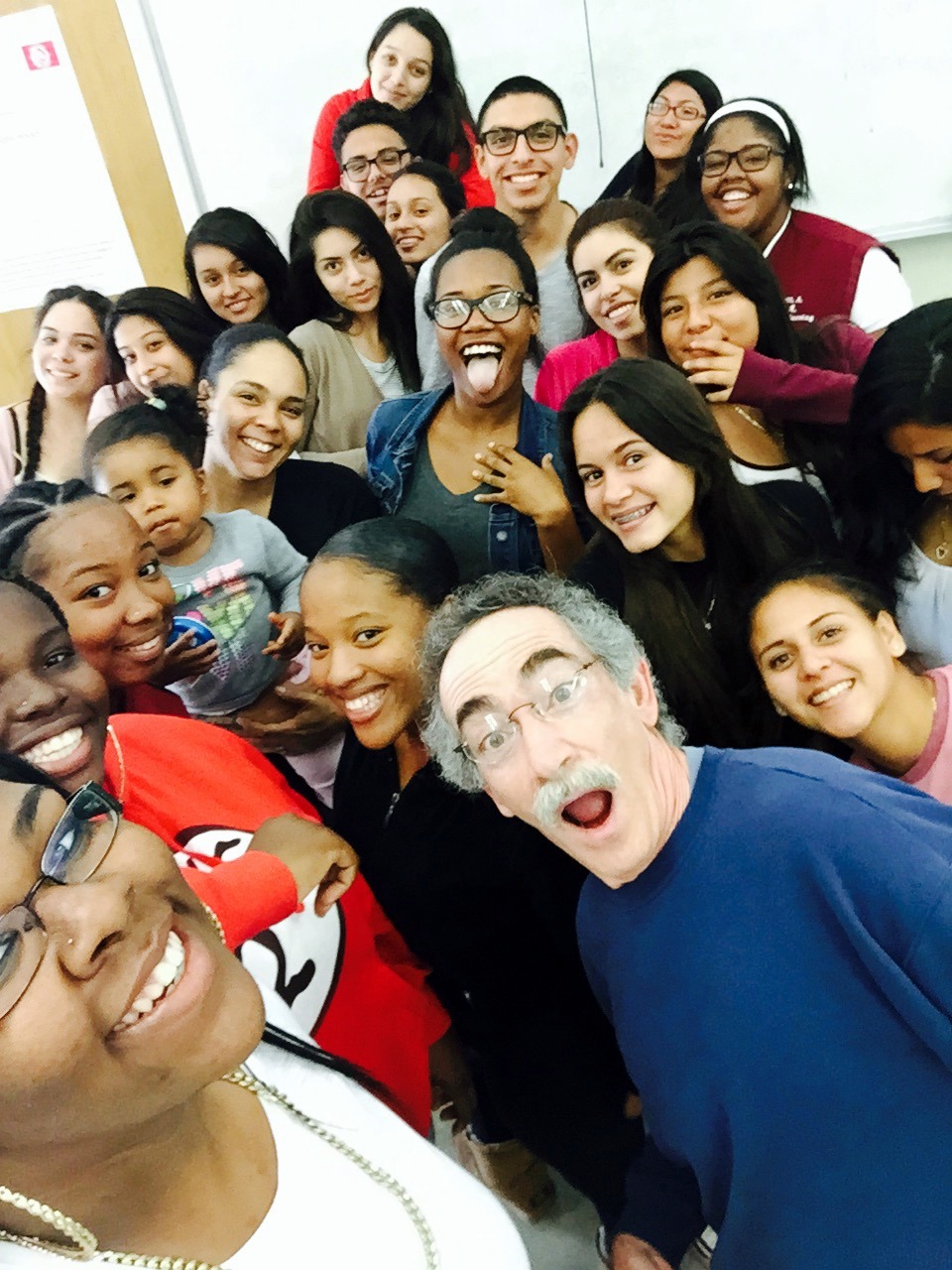
A small portion of one of my classes


Towards the end of the semester attendance becomes erratic due to overlapping student commitments; track and band practice, clubs, field trips and projects for other classes.  Attendance can suddenly dwindle to twelve to eighteen students. As the summer recess looms, the temptation to ditch a course that runs from 3:30 to 5:20pm is hard to resist, especially when it falls on a “half-day” where school is let out at 1pm.  Hanging around the campus for two and a half hours isn’t all that enticing.  For the seniors in the class, by the time May rolls around, they’re pretty much done and if they show up, it doesn’t guarantee their focus is on the workshop.

I tend to do my best work during this time because the smaller sized workshops enable me to focus more attention on students who need it.  Victor is one of those students. Shy, reclusive, introverted, he would often come to class late, timed perfectly to avoid the group warm-up and immediately try to blend into his surroundings. Pressed against the wall in the back of the class with his hoodie pulled down over the front of his face, he was invisible to the rest of the class, unless he got up to charge his phone.

Frequently I had to cajole Victor into participating. Often, he would just shake his head no. He would reluctantly join a group format but made minimal effort and barely spoke above a whisper.  Since my enrollment was 33 students, there was only so much time I could spend on encouraging him to participate.  But I knew this was the class for him. Peripherally I would catch him smiling at a game students would be playing or laugh at something that resonated with him. Our eyes would meet at such a moment and he would revert back to his introverted, sullen state.

When the class size was small, between 15 to 20 students I was able to involve Victor a little more, pairing him up with students he was comfortable with.  I found that he would seize up in formats that required an immediate response, but was more relaxed in ones where he was able to take his time to explore and discover.

Only 10 students showed up at a recent workshop. Victor was one of them. As a final project students are required to bring in a theatre game I have not done in class and conduct it. Five students brought in games and all required group participation. Victor joined in and he seemed to enjoy himself. Perhaps it was because his peers were in charge where they suddenly had a sense of ownership in the class, or there were fewer eyes on him.  It was a very relaxed, intimate session free of the usual ambient noise that made conducting a workshop difficult. 

One of my students conducting her final project.


With a half hour left to the workshop I decided to put Victor in a game called Lone Wolf with two other students, Breanne and Mike. In this game, which was taught to me by David Shepherd (co-creator of Compass and Improv Olympics) only one player can move and speak at a time. There is also a Viola Spolin game by the same name, but the emphasis is on multiple concurrent scenes. The class suggested a park as a location, with Victor, Breanne and Mike discussing how they felt about school.

Chairs were set up as a bench and the scene began with all three sitting down. One at a time, Victor, Breanne and Mike would stand up, say something, and then sit back down. The class laughed at how the game was being mocked, which is often the case when the rules of the format seem unreasonable or difficult.

I directed the three to get off the bench.  Breanne got up and created a water fountain, but exaggerated drinking from it to elicit laughter from the class. Victor got up and reprimanded her for making a mess. Mike got up and slipped on the wet ground from the water Breanne was wasting.

My next direction was for them to explore the environment and find details. Be as specific and realistic as possible. Victor examined a tree which had initials carved into it. He felt the coarseness of the tree against his hand and the indentation the carvings made. He was committed and focused on the discovery. Mike picked up trash from the ground and put it in a nearby garbage bin.  Breanne found a discarded kite and started to untangle the string attached to it.

The scene went on for almost ten minutes. Through a slow, thoughtful pace, a lovely scene evolved where Victor reveals that he is going to drop out and Mike and Breanne talk him out of it. All of this transpired as the exploration of the space continued, with specific environmental details making it more vibrant to the class.  The scene ended as the wind picked up, temperature dropped and it began to rain.

While I was proud of all three for working together and taking their time to create a realistic scene with humor that sprung out of the situation and characters, I was thrilled that Victor was able to commit to a format that required discipline and patience. It was the most natural I have ever seen him in class and from the expression on his face I knew he realized that he just had a breakthrough moment in the class.

I knew it was just a matter of time. I just had to be patient. 

After class Mike confided in me that Victor was actually thinking of dropping out due to feeling isolated and unenthusiastic about school.  As the result of two new friendships he developed from my class, Mike and Breanne, he decided to stick it out.  I choose Breanne and Mike to play with Victor because I knew he felt comfortable around them, without realizing they had developed a relationship outside of class and were about to embark on a scene that realistically reflected their dynamic.

With the right game and chemistry of players, it’s amazing what can be accomplished. 


Michael Golding is a writer, director and improv teacher.  He can be contacted for workshops, festivals and private consultations at migaluch@yahoo.com. Michael participated in the evolution of the Improv Olympics & Canadian Improv Games. Artistic director of the Comic Strip Improv Group in N.Y. & created the Insight Theatre Company for Planned Parenthood, Ottawa.  He is a faculty member at El Camino College in Los Angeles, working with at-risk teens and traditional students. He wrote and co-produced the documentary "David Shepherd: A Lifetime of Improvisational Theatre" (available for free on YouTube).  His book, Listen Harder, a collection of essays, curriculum and memorabilia on improvisation and educational theatre, is available on Amazon, Barnes & Noble and CreateSpace. Michael holds a BFA degree in Drama from New York University’s Tisch School of the Arts & an MA degree in Educational Theatre from NYU’s Steinhardt School of Culture, Education & Human Development. 


Wednesday, October 12, 2016

Missed Improv Opportunities by Michael Golding


This semester through the Compton division of El Camino College’s offsite program I was assigned to teach Theatre Appreciation at two inner city high schools in Los Angeles; Firebaugh High School in Lynwood and Compton High School in Compton.  Students receive college credit for attending the courses which run from 3:30 – 5:30pm twice a week.  Two weeks in, both courses were canceled due to low enrollment. This is a common occurrence for adjuncts who work with high school students. The disappointment cuts deep this time out. The students at both schools were excited with my learning by doing approach, which relies more on participating in improv games, formats and group collaboration, than listening to lengthy lectures. I was stimulated by the creative possibilities both classes offered and was already strategizing how to alter my curriculum to accommodate the specific needs of the students.

There were students in both classes who have previously taken Intro to Acting with me, where I take the same hands on approach, although there is a scripted element to the course where scenes and monologues have to be performed. In that course, I give the students the choice of finding a scripted scene or monologue to perform, or developing one through improv and creating a script based on it.  Since those students were already familiar with my style, it was forcing me to search out new ways to engage them so they could not anticipate outcomes. What I found endearing was that these students understood what was going on in the minds of the students who were working with me for the first time and discovering in a joyful way, I’m unlike any instructor they’ve had before. The learning by doing approach catches on quickly, and nothing gives me a greater satisfaction than monitoring the looks of new students engaging in the work for the first time, where I know they’re thinking “Where has this type of class been my entire life?”  It is a welcome outlet after being cooped up in school all day for them.
.
At Firebaugh High School in Lynwood, I had fourteen students registered and eleven at Compton High School. Smaller classes work better when it comes to at-risk populations where I can give more individual attention. But the college has a minimum requirement of twenty two students.  Sometimes I can sway the administration to extend the registration deadline, and make a case that the students attending will become ambassadors for the college. Canceling a course that they’re into will only diminish them, resulting in leeriness when contemplating signing up for future courses at the college.  My case fell on deaf ears this time out. Essentially the administration told me “Better luck next time.” Tell that to my bank account or the students who were on the precipice of a new exciting journey. 

Firebaugh High School

Francisco, a short, muscular, eighteen year old fireball of kinetic energy, confessed to me at my first workshop at Firebaugh High School that he wanted to be a stand-up comedian. He was always seeking out the comedic edge with anything he participated in. When I asked for a suggestion for an activity he offered “crucifixion.”  An activity that a group could do together, he proudly exclaimed “circle jerk.” He frequently got cheap laughs from the class by mocking the games. In many ways he reminded me of what I was like at fourteen, when I first started taking improv classes and I was looking forward to slowly changing his mindset from “it’s all about me” to “it’s all about the group.”  He developed a kinship with Donotus, a tall, lean, and lanky seventeen year old who fearlessly volunteered for every game, without paying attention to what the rules and objectives were and was frequently crestfallen when his noble attempts failed.

I paired the two up for  “Try that on for Size” where an activity, such as washing the dishes is given, and the players have to come up with different explanations while pantomiming the same motion for the activity; (Example: “What are you doing?” “I’m trying to raise the dead. Try that on for size!”). After a few failed attempts, Francisco and Donotus clicked with the game, and were thrilled with how they were bouncing off each other and developing a rhythm.  As I drove home after class I spotted the two walking together on the sidewalk, plotting away with the possibilities of future collaborations. 

Compton High School

My Compton High School class had nine female students and two male, one of which was a dapper seventy year old man named Lawrence. The offsite program allows adult students to attend high school courses if the schedule fits their needs better. It’s an interesting dynamic. Depending on the age gap, frequently the adults take on a paternal role with the teenagers. Lawrence had a thoughtful, soothing effect on the other students, who readily accepted him. In my experience, inner city students have a more respectful attitude towards elderly people, usually because their grandparents often live with or are raising them. It was a joy to watch Lawrence immerse himself in “Tableau,” a game where players freeze in a pose that creates a picture of  a location, such as McDonald’s, the beach or a bank. Now retired, Lawrence wanted to pursue the college degree that eluded him in his youth and I was eagerly looking forward to becoming part of his journey and the various roles he would play with the students in scenes. 

As I torment myself with might have been this semester, I hope that the four two hour workshops both groups had with me was enough to inspire an interest in the work and future theatre courses. For the adjunct instructors, the offsite program is an admirable endeavor, designed to inspire high school students to consider college, what will be required of them and envision a life beyond high school. But the reality from the perspective of the college administration is it’s all about money and numbers. Pack them in, espouse the virtues of the college then send them on their way. Ideally, the college would love for me to have forty students in each class, which I have at times.  Even though I have developed a successful structure that involves group warm-ups and collaboration exercises, often the momentum of the class slows down due to crowd control when the class is that large.  Twenty two is the way to go. Even better if it’s less.

The ongoing uncertainty of committing to a semester followed by the disappointment of an abrupt cancellation has forced me to decide whether I want to continue with this program. Aside from the financial hardship, there is an emotional toll, because I cannot teach without bonding with my students and I’m already feeling the loss over the missed opportunities of this semester.  It was neither the fault of the students nor I that the classes were cancelled. What we’re all feeling right now is anger, with no one to direct it to.  I love what I do, but my heart has been broken so many times in the past with this program that it’s beginning to develop scar tissue.  There is no closure when a course is suddenly cancelled and I don’t have an opportunity to say goodbye to the students. At least I had two great weeks with both groups. We were connecting and I know that I was opening the door to new possibilities for the students. That’s something to be proud of.      

That said, imagine what I could have accomplished with both groups if I had them for three months.

Workshop director suddenly at liberty.


Michael Golding is a writer, director and improv teacher.  He can be contacted for workshops, festivals and private consultations at migaluch@yahoo.com. Michael participated in the evolution of the Improv Olympics & Canadian Improv Games. Artistic director of the Comic Strip Improv Group in N.Y. & created the Insight Theatre Company for Planned Parenthood, Ottawa.  He is a faculty member at El Camino College in Los Angeles, working with at-risk teens and traditional students. He wrote and co-produced the documentary "David Shepherd: A Lifetime of Improvisational Theatre" (available for free on YouTube).  His book, Listen Harder, a collection of essays, curriculum and memorabilia on improvisation and educational theatre, is available on Amazon, Barnes & Noble and CreateSpace. Michael holds a BFA degree in Drama from New York University’s Tisch School of the Arts & an MA degree in Educational Theatre from NYU’s Steinhardt School of Culture, Education & Human Development. 


Wednesday, October 14, 2015

Life Story By Michael Golding


In my college workshops with at-risk high school students, I try to utilize their life experiences as much as possible when exploring themes, situations and characters in scenes, games and formats. The emphasis is on realism, which is often not the case with this population who lean more towards outlandish, unrealistic, and violent scenarios.

An in-class written assignment I use to elicit those experiences is called Life Story.  The set-up is that a producer bought their life story to be turned into a play. The student has to come up with a title, genre, and a few sentences describing what the play is about.

As I read through the papers, scene ideas pop out at me as I gain insight into who these students are. I write down notes on each paper to get the student to think a little deeper about the story.  This semester’s batch is particularly intriguing;

Life of Color (drama) A student deals with stress and anger through painting. Color saves me. Art saves me. Art takes all the bad thoughts away when I paint. I consider myself art. I myself am art. Art is everything to me. (My note: Lovely. Let’s come up with a scene where you encounter stress and anger, then deal with it through the activity of painting.)
 
 Beautiful Tragedies (drama/horror) A girl who lives with her grandmother and an aunt who is a felon, learns to deal with police, prison and the will to try and overcome it all. (My note: I’d like to see more of the characters who inhabit this world of yours.)

Addicted (suspense/drama) A girl who is being raised by a single mother, who she rarely sees, falls for someone that she knows is an asshole but can’t seem to let go. (My note: Let’s see a scene where she first met and fell for this guy.)

Roller (drama/romance) Girl is involved with a boyfriend who is into serious drugs and becomes aggressive when using. (My note: Can we see a scene about what he’s like when he’s not using?)

Viewing Things Differently (drama) A close friend’s betrayal and the repercussions that follow. (My note: Let’s see a scene about what the friend was like before the betrayal.)

Records (drama) A young teenage girl’s life depends on records, gets hired to work in a record store. (My note: Let’s do a scene where you apply for the job).

Ricardo (drama) Argument with brother leads to a fight that goes too far. (My note: Do you and your brother fight often? Over what? Are the arguments ever resolved non- violently? If so, let’s see one.)

There are students who don’t exactly do the assignment as described,  but still offer something interesting to work with;

Game Day (drama) A teenage boy comes up with an idea for a million dollar game and releases it on the internet. (My note: Let’s see a scene where you are selling this game to someone.)

Run Away Fugitive (action) Teenage boy breaks out of prison, steals a car, changes his appearance and goes on the run. (My note: What crime did he commit to be incarcerated? How does he survive on the run?)

The 411 (drama) People are always asking a teenage boy how to do stuff, because they assume he knows everything. Turns out, he does. (My note: Let’s explore various moments where people assume this of you.)

Money Gang Bang (action) Gang member gets shot in the forehead by a rival gang drive by. (My note: Let’s explore what leads up to that act and the repercussions afterwards.)

Shippers Found Dead (horror) Tech company uses zombies as slave labor to ship out merchandise. (My note: Can we come up with a scene that explores how the shippers became zombies?)

Once I’ve handed back the papers with my notes, I then get the students to come up with a who/what/where scene based on their story that can be explored through improv on stage. The student doesn’t necessarily have to act in their own scene. He or she can cast and direct it. Additionally, the student has to design a set floor plan, based on floor-plan symbols from Viola Spolin’s Improvisation for the Theater, which is a recommended textbook in my class.  The floor-plan provides the student with a sense of staging, set design and focusing on the where.

When the scenes are up on their feet, I begin to side-coach as the students improvise to uncover the beats. My directions hone in on specific improv skills, which are also essential life skills.

Side coaching directions:

1.     Five Second Delay:  Players have to wait five seconds before responding to each other.

2.     Contact (Spolin):  Players have to touch each other in a different way whenever they say something.'

3.     Inner Monologue:  Thirty second monologue on what is going on inside player’s character’s head.

4.     Gibberish:  Speaking in an unknown language.

5.     Explore activity:  Players have to add substance and detail to what they are physically doing.

6.     Focus on emotion:  Players have to explore what they are feeling at that moment and find a way to express it physically.

7.     Switch time:  Scene is taken either ahead or back in time.

8.     Switch location:  Scene continues in a different location.


Looking over the life stories from this class, various themes begin to reveal themselves to me; betrayal, friendship, single parent households, social inadequacy, anger, stress, work, fear of future, substance abuse, gang-banging, sibling rivalry. This group has given me a lot to work with this semester and they discovered that they have a lot more in common with one another than originally thought. Shared stories bring students together. The bonding process has begun.


Michael Golding is a writer, director and improv teacher.  He can be contacted for workshops, festivals and private consultations at migaluch@yahoo.com. Michael participated in the evolution of the Improv Olympics & Canadian Improv Games. Artistic director of the Comic Strip Improv Group in N.Y. & created the Insight Theatre Company for Planned Parenthood, Ottawa.  He is a faculty member at El Camino College in Los Angeles, working with at-risk teens and traditional students. He wrote and co-produced the documentary "David Shepherd: A Lifetime of Improvisational Theatre" (available for free on YouTube).  His book, Listen Harder, a collection of essays, curriculum and memorabilia on improvisation and educational theatre, is available on Amazon, Barnes & Noble and CreateSpace. Michael holds a BFA degree in Drama from New York University’s Tisch School of the Arts & an MA degree in Educational Theatre from NYU’s Steinhardt School of Culture, Education & Human Development.  


Monday, June 2, 2014

David Shepherd's Strategies for Writing Scenarios


A recently discovered  item from David Shepherd's archives, written in 1982.   


A “scenario” is a sequence of events, such as “the scenario for the outbreak of war was different in 1914 from 1939.”

When we write a scenario, we’re creating a sequence of events for a group of players to play. To make real.

Reality in the scenario for World War I includes the assassination of an Arch Duke, Germany’s bid for colonies, etc. Conflicts in real Wheres.

Reality in a scenario we write must be different. Why?  Because on our stage there is no real Where. Only an imagined one.

So for us writing a scenario becomes making Wheres.  Because we can’t show what happens until we provide the context in which it’s happening.

Compass scenario play "Enterprise" (1955)

For instance, a husband and wife arguing becomes a totally different happening when set against different Wheres. If they’re arguing in a baby’s bedroom, it’s happening differently than it would in the bedroom of children who’ve left for college. If the argument takes place in a concentration camp, it’s not the same as an argument on Miami Beach.

How does the writer of scenarios define the Where?

By describing it’s color or shape?  No, because we have no set – except what the player can create through activities, physical response or emotional response.

Notice: words don’t count for much in creating a Where. We describe a Where better by interacting with it than by talking about it.

We can ask the players to interact with a Where by cleaning it, building it, using it, destroying it even, rather than describing it. In fact, we don’t sit around in real life describing our Wheres unless we are interior decorators.

Here are some guidelines for writing a scenario: 

Activity: cooking, playing cards, dancing, laying carpet……
Physical: it’s freezing, there’s a smell of soup cooking, it’s dark……
Emotional: they’re afraid of each other, they love the sun…..

Finally, tell us What Happens by the end of the improvisation.  In other words, tell us what goes into the improvisation at the top, and what comes out at the end.

Don’t tell us what happens in the middle.  Don’t give us a blow-by-blow account. Don’t give us a dozen Exits and Entrances. Don’t write dialogue. All of that is for the players to improvise.

To help the players understand the scenario in your head, make sure we understand the time sequence of the improvisations. For instance, one improv could take place “at midnight on the couple’s tenth anniversary.” Another might take place “two martini’s later” or “twenty years before.”

Think of your scenario as pieces snipped out of time, out of the fabric of our lives together.  It takes only 3-10 such pieces to tell a story.

Remember: Just as a poem or story, your scenario will probably have to be rewritten several times before it expresses your deepest and most dramatic insights.

Scenario sample by David Shepherd


Michael Golding is a writer, director and improv teacher.  He can be contacted for workshops, festivals and private consultations at migaluch@yahoo.com. Michael participated in the evolution of the Improv Olympics & Canadian Improv Games.  Artistic director of the Comic Strip Improv Group in N.Y. & created the Insight Theatre Company for Planned Parenthood, Ottawa.  He is a faculty member at El Camino College in Los Angeles, working with at-risk teens and traditional students. Michael holds a BFA degree in Drama from New York University’s Tisch School of the Arts & an MA degree in Educational Theatre from NYU’s Steinhardt School of Culture, Education & Human Development.


Sunday, May 4, 2014

Improv Cards by Michael Golding


I recently spent a week with David Shepherd, the father of improvisation, to attend his tribute and to work on getting his archives in order.  Since I was staying in a cottage on his property, we had an abundance of quality time together.

David immediately writes down every interesting idea that he hears (“Otherwise you will forget it!”) on 3x5 index cards.  There’s always a stack nearby. Strewn all over his office, you’ll find cards with a phrase, exchange or just a word or two that is designed to open up a plethora of improv possibilities.

One morning over breakfast, we talked about a close mutual friend, who to this day, still mocks me for the amount of preparation I invest in my workshops.  He finds that I put unnecessary pressure on myself. Considering that I’ve been doing this for over thirty years, couldn’t I simply walk into a workshop and conduct it off the top of my head? I suppose I could – but the mere thought makes me shudder.

As David taught me, my plans are written out on 3x5 index cards. Some are detailed, with the plans broken up into warm-ups, technique, formats, closure.  Others, just a series of games to choose from, based on the atmosphere of the group.  On the back of the cards, I also have a plan “B” – just in case my original design isn’t working.   I even have a plan “C.”


The workshop card is either tucked in my back or breast pocket for quick reference.  Students are always curious about the cards.  More so when they try to peek over my shoulder to see what was written, and I shield it from them in mock shock, as if they’ve overstepped a boundary.  Sometimes, while looking over a card, I make it seem like I’m thinking out loud, wondering what to do next; “No, I don’t have the heart to try this today.  Good God, what was I thinking when I wrote this one down?  Okay, this is just flat-out sadism on my part!”   

I also use the index cards for student suggestions – handing them out when I need ideas for themes, phrases, scene ideas, locations, and characters.

Remember, I’ve been doing this for over thirty years.  Unfortunately, I’ve inherited one of David Shepherd’s notable attributes; I can’t throw anything out.

So, I have boxes of 3x5 index cards of workshop plans and student suggestions stashed in a closet in my office.  I don’t know what to do with them.  Make a collage or construct a piece of modern art with them?  Try to find a linear thread for the world’s longest Harold? 

I’ve thought about recycling student suggestions for future workshops with different groups, but that doesn’t feel right.  Every idea should come out of the group you’re presently working with.  It has to be organic.

When my wife and I go grocery shopping, the list is made out on a blank 3x5 index card.  There are always fresh ones lying around.  One time while shopping, I noticed that the list was written on the back of a workshop card.  It was an introductory workshop, something, ironically, I could have done off the top of my head without preparing. Yet, I exploded at my wife.

“How could you write on the back of this card?  This could have been a break-through workshop!”

“Was it?”

“No!  But that’s beside the point!”

Yes, it is a magical adventure to live with the wonder that is me.

Another time, a friend picked up what he thought was a blank index card from my office to write down a recipe for his wife.  Later, his wife noticed what was written on the other side.  In very small print was “Lick my ear,” a line suggested by a student.  It didn’t help my friend that a heart was drawn over the “i.”

Sometimes I fall behind keeping a fresh stack of cards in my office and find myself scrambling when I can’t find a clean one to write on.   Once, out of necessity because I was running late for a workshop, I designed a plan on an 8x10 piece of paper.

It didn’t feel right – and I was off my game for that particular workshop. I needed something that I could just gaze at in my palm quickly, rather than unfold what felt like an ancient scroll to me.  The cards guide me.

As boxes continue being filled with used index cards, I wonder if they’ll eventually end up in my own archives one day – perplexing future generations of improvisers trying to figure out the connection between improv and a grocery list.


Michael Golding is a writer, director and improv teacher.  He can be contacted for workshops, festivals and private consultations at migaluch@yahoo.com. Michael participated in the evolution of the Improv Olympics & Canadian Improv Games. Artistic director of the Comic Strip Improv Group in N.Y. & created the Insight Theatre Company for Planned Parenthood, Ottawa.  He is a faculty member at El Camino College in Los Angeles, working with at-risk teens and traditional students. He wrote and co-produced the documentary "David Shepherd: A Lifetime of Improvisational Theatre" (available for free on YouTube).  His book, Listen Harder, a collection of essays, curriculum and memorabilia on improvisation and educational theatre, is available on Amazon, Barnes & Noble and CreateSpace. Michael holds a BFA degree in Drama from New York University’s Tisch School of the Arts & an MA degree in Educational Theatre from NYU’s Steinhardt School of Culture, Education & Human Development.