Showing posts with label Janet Coleman. Show all posts

Wednesday, November 20, 2013

Workshop Memories by Michael Golding


When it comes to teaching improv, I’ve been fortunate that the majority of my gigs have been working for colleges and theatre companies, where all I have to do is show up and do my thing.  I admire my peers who have forged out a living being on the road conducting workshops and attending festivals.

While I’ve had my share of independent workshops, financially, more often than not, I was lucky to break even.  I’ve never regretted doing those workshops, because of the personal and artistic rewards.  Two independent workshops come to mind.

In New York, several months after I moved on from the Comic Strip Improv Group, I was jonzing for a creative outlet.  So, I started a summer workshop in the village at a loft space on Bleecker Street, above the Bitter End nightclub.  While I was the main facilitator, the workshop was designed for experienced improvisers to bring in their own games and take turns leading.  We always started with a group warm-up, followed by a few skills games, two person scenes, group scenes and a closure exercise.  Frequently, someone would come in with an idea for “an experiment” and the entire session would be devoted to that; such as the time where we started with an animal character exercise, which morphed into a thirty minute cocktail party as our animal characters, followed by scenes which explored what happened before and after the party.

Site of the village workshop.
The best part about the village sessions was after the workshop, when we would hit the diner across the street and go over what we accomplished.  Those discussions would go on for hours. It was a wonderful way to spend a Saturday afternoon.  David Shepherd played regularly; as did some of the members from my old Comic Strip group, and Janet Coleman (author of The Compass) joined us for a memorable session where the two of us played a couple whose relationship was explored over the years solely through the activity of washing dishes. 

The second one took place in Los Angeles, and was responsible for my renewed interest in improv.   At the time, my improv activity had dwindled and I was spending more time focusing on my career as a writer.  My last teaching gig had been a successful semester at Los Angeles City College, but a transit strike a month into my second class abruptly ended the course, followed by budget cuts which ended my association with the college.  I was a little resentful over that.  The Canadian Improv Games had recently dragged me back into the fold after a decade’s absence, but that was a once a year shot conducting workshops at their national festival.

A new acting school called the Theatre Academy opened in North Hollywood, and I was hired to conduct an eight week improv course, meeting on Friday evenings.  Unfortunately, unforeseen complications prevented the administrators of the school from doing a thorough marketing job, and by the time my course was to begin, no students had signed up.

Since the space was available, the administrators allowed me to use it as I saw fit, reasoning that perhaps it would develop interest in a future class.  I decided to invite Team Hollywood, my cycling club, to participate, using my usual format of warm-ups, games, formats and closure exercises.  With the exception of a few who had friendships outside of the club, most of us only saw each other once or twice a week in spandex. Only two had a performance background.  The backgrounds of the cyclists in Team Hollywood was diverse; sound engineer, grip, line producer, accountant, physical therapist, notary, airline pilot, doctor, lawyer, nurse, graphic artist, teacher, truck driver, counselor, police officer.  One of the members of our club frequently said “If it wasn’t for cycling, none of us would be friends, considering how diverse our backgrounds are.” 

Team Hollywood.
Eight to ten members attended the sessions on a regular basis and from the first workshop, they all came off as experienced improvisers.  Perhaps it was because we already had a familiarity with each other, or we were just thrilled to see each other in civilian clothes.  Regardless, they took to the games with complete abandon.  After the first session, the wife of the president of Team Hollywood told me “I can’t even get him to play Charades at parties. Now, he can’t stop talking about your workshop.”

In-jokes were a big part of our sessions, and frequently characters were based on people we all knew.  The workshop atmosphere was relaxed and casual, more so than others I’ve conducted with professionals.  After the sessions, we would adjourn to Pitfire Pizza nearby for a late dinner, and revel in what we had just accomplished.

We all got to see facets of each other we’ve never seen before – and I was impressed by how open and honest we were in the workshops.  When a friend of mine, who is a professional improviser, came in as a guest, I paired him up with a member who I knew was plagued with anxiety issues.  At first, she didn’t want to participate and admitted she was intimated and anxious at the prospect of playing with him.  So, we decided to make the scene about a first date – which involved anxiety and intimidation.  During the course of the scene, the date turned into a status power play, ending with the woman rolling my friend up in a rug.  After the scene, she admitted that was the first time she felt exhilarated after a scene, rather than relieved that it was over.   My friend was convinced that she was a professional improviser.

Team Hollywood at the Writers Guild for a staged reading of one of  my screenplays.

By the end of the Team Hollywood sessions, I realized that cycling and improvisation shared the same skill set, which is why the workshops were so successful.  Both rely on trust, agreement, listening, awareness and cooperation.  But, I would have to say that being in the moment is at the top.  In cycling (and improv) if you’re not completely in the moment, things can go bad very quickly.

I have the scars on my body to prove that.


Michael Golding is a writer, director and improv teacher.  He can be contacted for workshops, festivals and private consultations at migaluch@yahoo.com. Michael participated in the evolution of the Improv Olympics & Canadian Improv Games.  Artistic director of the Comic Strip Improv Group in N.Y. & created the Insight Theatre Company for Planned Parenthood, Ottawa.  He is a faculty member at El Camino College in Los Angeles, working with at-risk teens and traditional students. Michael holds a BFA degree in Drama from New York University’s Tisch School of the Arts & an MA degree in Educational Theatre from NYU’s Steinhardt School of Culture, Education & Human Development.


Tuesday, October 1, 2013

The Improv Archives by Michael Golding


Somehow, I’ve become the improv archivist.   Always had a healthy stash of vintage memorabilia, as a result of my friendship with David Shepherd.  The basement of his country house in Armonk, New York, was a shrine to Compass; posters, flyers, scenario plays, press articles and pictures, neatly preserved in albums and file folders.  Unfortunately, a flood in the early 1980s took out nearly a third of his collection, including some reel-to-reel recordings of Compass.

  
Shortly after the 2009 Canadian Improv Games National Festival (inspired by David’s Improv Olympics), Willie Wyllie, co-founder of the format, recruited me and Mike Fly, an improviser and filmmaker from Toronto (Sexy Nerd Girl, Versus Valerie and Space Janitors) to shoot a series of interviews with David on his fifty-plus year career in improv.  Originally intended as a web series, Mike Fly had a vision that resulted in us making a full-length documentary, much to the chagrin of Willie, who was financing the project.  I don’t think I’ve ever worked with a director who was more confident, versatile and innovative than Mike, which is why I was surprised when he confessed one night that this was his first feature-length project.

Mike Fly and I spent four days filming David at his home in Belchertown, Massachusetts.  When it came time to get digital shots of his pictures, I was shocked when David came out of his office with a box, and dumped the contents onto the floor.   Gone were the days of his meticulous file keeping system. Mike set up the borders for the pictures, and one by one I handed him a photo to be digitized.  This process took us close to two hours - six, if Mike didn’t stop me from commenting on every shot (“Holy shit! Do you know what this is? It’s the holy grail of improv pictures!”).

Compass cast: Severn Darden, Larry Arrick, Elaine May, Shelley Berman, Mike Nichols, Rose Arrick & Barbara Harris - 1955.
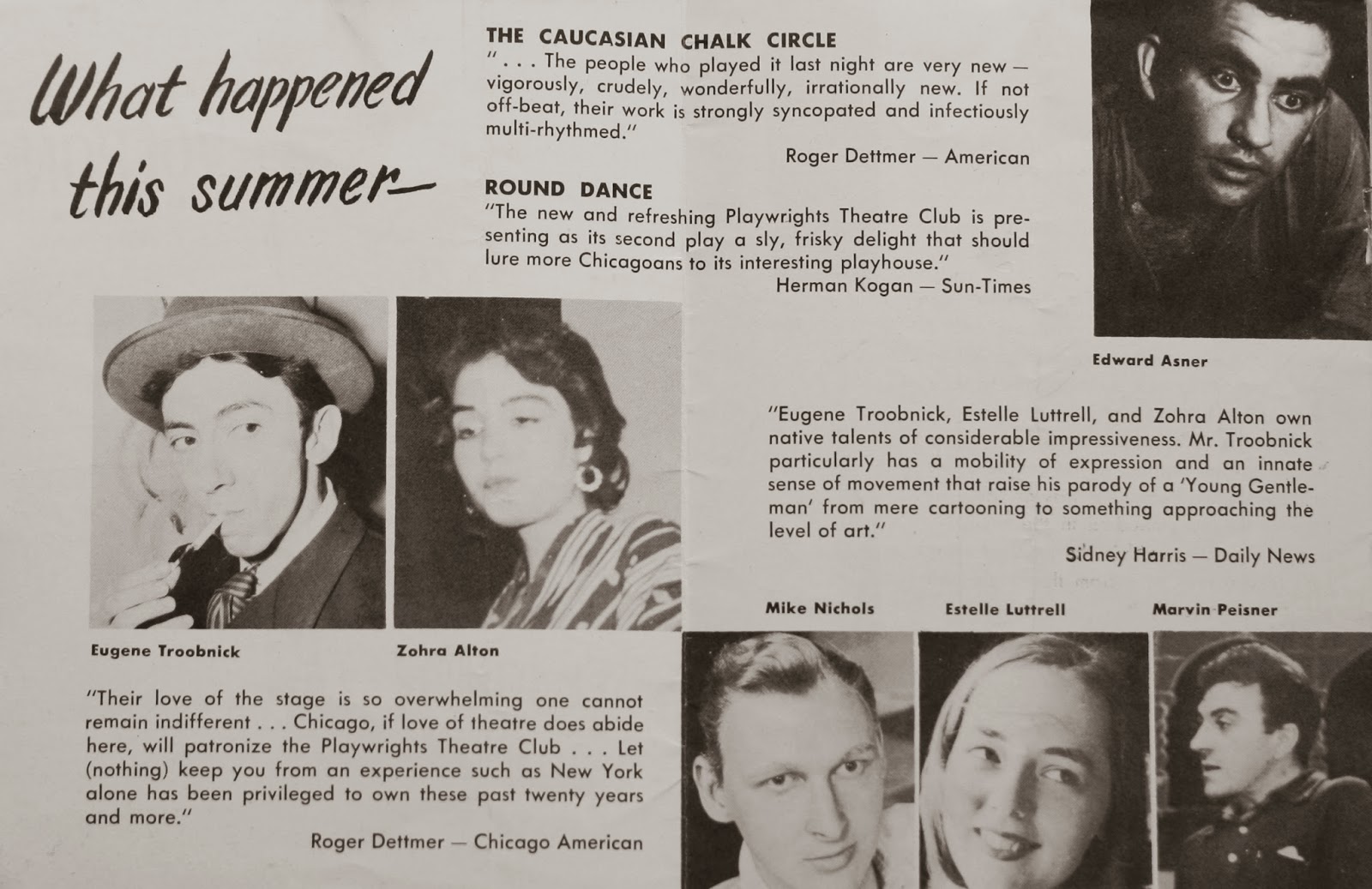
Back home in Los Angeles, I plowed through the pictures on my laptop that Mike emailed me from Toronto.  We categorized them into files (Playwrights Theatre Club, Compass, Second City, Improv Olympics, etc.).  The largest was our miscellaneous file - great shots, but not relevant for the documentary. 

Little known Shepherd format.  Unfortunately, not enough material to cover in documentary. 

Despite the vast collection David gave us, there were still gaps in the timeline.  We managed to fill some of those in with pictures from the archive department at the University of Chicago.  David had donated a great deal of his memorabilia to the university.  I procured several discs from the department, which included a healthy selection of shots from the early days of Second City.  Again, many were not relevant for the documentary, but still spectacular in terms of improv history.  Those found a special home in my laptop.

Robert Klein & Fred Willard, Second City 1965
I started scouring the internet for pictures I knew existed, but weren’t in David’s or the University of Chicago’s collection.  Image search from Google and Bing were helpful, but the biggest finds came from magazine and newspaper articles from the late 1950s and early 1960s.  Maybe one or two found their way into the documentary.  Others, yep, express lane into my laptop.

Paul Sand, Severn Darden & Melinda Dillon in an ad selling advertising to liquor companies.

Shortly after we made the documentary available on YouTube, I realized that the hundreds of pictures nestling in my laptop weren’t doing anyone any good by remaining there.  So, I decided to share them with the improv community, mostly through various Facebook improv pages.  The response was immediate, unexpected and gratifying.

Alan Arkin, Paul Sills and Anthony Holland at Second City, 1961
First person I heard from was Aretha Sills, who told me that her father Paul was not great at holding onto things from the early days.  So, it was a pleasure to send her shots from Playwrights Theatre Club and Compass.  Sheldon Patinkin, with his incredible memory, was able to recall touching, personal anecdotes that provided a wonderful background to the pictures I was posting on a Chicago Theatre site.  A group picture from Jo Forsberg’s Player’s Workshop evoked a warm memory from George Wendt about an improviser he was enamored with. 

George Wendt in Jo Forsberg's Player's workshop - 1973
When Bernie Sahlins passed away earlier in the year, I realized that I had a picture of him from my miscellaneous file in front of Second City on their opening night in 1959.  That became the most re-posted photo from my collection on Facebook.
Bernie Sahlins

Soon, people were coming to me with requests.  Charna Halpern was moving i.O. to a different location in Chicago. Did I have any unique shots of Del Close? Yes, I do. 
 
Joan Rivers & Del Close at Second City, 1961.


The curator of the Viola Spolin library exhibit at Northwestern University inquired if I was willing to clarify some photos and documents?  More than happy to.  A director from Second City in Chicago contacts me about submitting pictures for their upcoming celebration of the Playwrights Theatre Club. Done.  There is a Compass Improv Festival in St. Louis, Missouri.  Do I have shots from the original St. Louis Compass?  Sure do.

Playwrights Theatre Club brochure - 1953.
 

Jerry Stiller, Nancy Ponder & Alan Arkin at the St. Louis Compass, 1959.

These days, I’m trying to convince David Shepherd that a book of his vintage shots would be of enormous interest to the improv community.  Aside from the documentary, many have appeared in Jeffery Sweet’s Something Wonderful Right Away and Janet Coleman’s The Compass.  But believe me my improv brothers and sisters, there are scores of other pictures that have not been viewed by the public for many decades.  It’s time they found their way back into the light.


Michael Golding is a writer, director and improv teacher.  He can be contacted for workshops, festivals and private consultations at migaluch@yahoo.com. Michael participated in the evolution of the Improv Olympics & Canadian Improv Games. Artistic director of the Comic Strip Improv Group in New York & created the Insight Theatre Company for Planned Parenthood, Ottawa.  He is a faculty member at El Camino College in Los Angeles, working with at-risk teens and traditional students. His screenplay credits include "Celebrity Pet" for the Disney Channel and the documentary "David Shepherd: A Lifetime of Improvisational Theatre."  His book, Listen Harder, a collection of essays, curriculum and memorabilia on improvisation and educational theatre, is available on Amazon, Barnes & Noble and CreateSpace. Michael holds a BFA degree in Drama from New York University’s Tisch School of the Arts & an MA degree in Educational Theatre from NYU’s Steinhardt School of Culture, Education & Human Development.