Wednesday, November 6, 2013

Improv's Three Sources

A brief unpublished piece by David Shepherd - written in 1984, shortly after returning to New York from Chicago where he was producing the Jonah Complex and the Improv Olympics with Charna Halpern.
  
        How to Get Content into Improvisation By David Shepherd

David Shepherd in the moment.


There are three sources available for improving improvisational content:  the spectator, the player, and the producer.

(1)   The spectator:  Go to an audience that already has something to say – or that needs to be said for them.  When you improvise for people who have something on their minds besides television, it’s easy to elicit suggestions relevant to that group of people at that moment in time.
Audience at Compass, 1955.
Alternatively, train the audience by presenting models of the kinds of suggestions you want, and make clear that you will only accept the best suggestions.

Audience suggestion guidelines for David's Responsive Scene radio show - 1972.

(2)   The performer:  How much does a player know about being a surgeon or a prostitute?  If the performer knows nothing about these professions, empathy is everything.   Play your own instrument, tuned to the key of surgeon or prostitute.  How much can you feel? The fuller the feelings, the fuller the character, as well as the content.

Prostitute soothes nervous first time client.

(3)  The producer:  The producer can choose a theme for an entire improvisational performance, such as “Fathers” or “Father’s Day” or “Revolution and Independence” for July Fourth.  The producer can also single out the suggestion of a single player or spectator to be used, or the topic might be a consensus of the audience or players, solicited by the producer.

Audience member offers suggestion for "2 Bit Poem" format.


©  Group Creativity Projects 1984


Michael Golding is a writer, director and improv teacher.  He can be contacted for workshops, festivals and private consultations at migaluch@yahoo.com. Michael participated in the evolution of the Improv Olympics & Canadian Improv Games. Artistic director of the Comic Strip Improv Group in N.Y. & created the Insight Theatre Company for Planned Parenthood, Ottawa.  He is a faculty member at El Camino College in Los Angeles, working with at-risk teens and traditional students. He wrote and co-produced the documentary "David Shepherd: A Lifetime of Improvisational Theatre" (available for free on YouTube).  His book, Listen Harder, a collection of essays, curriculum and memorabilia on improvisation and educational theatre, is available on Amazon, Barnes & Noble and CreateSpace. Michael holds a BFA degree in Drama from New York University’s Tisch School of the Arts & an MA degree in Educational Theatre from NYU’s Steinhardt School of Culture, Education & Human Development. 

Wednesday, October 23, 2013

David Shepherd's State of Improvisation


Thirty years ago, David Shepherd wrote an essay on the current state of improvisation.  Unfortunately, he didn't work on it further beyond the first draft and it's been nestling in my files since then. I recently took a look at it, and believe that many of the ideas and concepts David brings up are relevant to the current improv scene.  Would love to hear how the improv community feels about this. 

The Improvisational Scene: 1954 – 1984

By David Shepherd


In the 1950s, improvisation was widely successful for the same reasons I was originally attracted to it:

  •   Scenarios were fashioned without the meticulous work of the playwright.

  •   Players responded relevantly to the taste, mood, or concerns revealed by the audience’s suggestions.

  •  Plays were mounted with a minimum of memorization and rehearsal, sustaining freshness and  spontaneity.
(Omar Shapli & David Shepherd at Compass, 1955.)


But by the sixties, because of the success of Nichols and May, Mort Sahl, and others in taming hostile nightclub audiences, improvisation had become a tool for different purposes. 

  • The audience challenged performers to improvise the obscene, the outrageous, the unimaginable.

  •  Performers began to enjoy “laundering” audience suggestions to make them presentable.

  •  Improvisation became tied exclusively to comedy rather than content.


In the seventies, the focus of improvisation shifted from the nightclubs to television.  Rather than offer suggestions, the audience began to consider itself situation comedy writers for the stand-up “comics” improvisational players had become. Rather than take their cues from their own understanding of life, performers improvised what they remembered from soap operas and talk shows. 

(Mike Nichols & Elaine May.)
Now, in the eighties, improvisation seems to be headed down a disastrous path.  Last year, I saw the same “deep political insight” being developed by several improvisation companies, namely, that Ronald Reagan was really dead.  Now that their “corpse” has become president of the United States, I wonder what new insights we can expect from any of the hundreds of improvisational companies though-out the country.

Of course, if you believe in the basics defined by Viola Spolin (as I do), you know the bottom line of improvisation is intuitive, not intellectual.  What we are getting, however, is performers who operate almost exclusively from the head and audiences who hunger for “guts” – the more obscene, absurd, or bizarre the better.

The very success of improvisation on late-night TV has shifted the ideal away from the celebratory cabaret of a Paul Sills to the put-down skills of a Chevy Chase.  Creating the “where” has been replaced by choosing a “what,” from a stock of social pathologies’ promoted by the media.

So, improvisers of the eighties: when you go off to play with your public, keep in mind that the audience has been well-trained thru comedy writing and casting to expect a laugh every eight seconds. (That’s about a thousand gags in a row for two hours)

Audiences of the eighties: understand that many improvisers are not interested in revealing their identities or values, but only in twisting the situation you suggest to work up a routine for their “Saturday Night Live” audition.

We’ve reached a point where improvisation is successful to the extent that it has no similarity to real feelings or real life.  The stage is used to evade rather than explore the details of living in the decade whose fourth year has been so well publicized.


Michael Golding is a writer, director and improv teacher.  He can be contacted for workshops, festivals and private consultations at migaluch@yahoo.com. Michael participated in the evolution of the Improv Olympics & Canadian Improv Games. Artistic director of the Comic Strip Improv Group in N.Y. & created the Insight Theatre Company for Planned Parenthood, Ottawa.  He is a faculty member at El Camino College in Los Angeles, working with at-risk teens and traditional students. His screenplay credits include "Celebrity Pet" for the Disney Channel and the documentary "David Shepherd: A Lifetime of Improvisational Theatre" (available on YouTube).  His book, "Listen Harder" a collection of essays, curriculum and memorabilia on improvisation and educational theatre, is available on Amazon, Barnes & Noble and CreateSpace. Michael holds a BFA degree in Drama from New York University’s Tisch School of the Arts & an MA degree in Educational Theatre from NYU’s Steinhardt School of Culture, Education & Human Development.

Tuesday, October 1, 2013

The Improv Archives by Michael Golding


Somehow, I’ve become the improv archivist.   Always had a healthy stash of vintage memorabilia, as a result of my friendship with David Shepherd.  The basement of his country house in Armonk, New York, was a shrine to Compass; posters, flyers, scenario plays, press articles and pictures, neatly preserved in albums and file folders.  Unfortunately, a flood in the early 1980s took out nearly a third of his collection, including some reel-to-reel recordings of Compass.

  
Shortly after the 2009 Canadian Improv Games National Festival (inspired by David’s Improv Olympics), Willie Wyllie, co-founder of the format, recruited me and Mike Fly, an improviser and filmmaker from Toronto (Sexy Nerd Girl, Versus Valerie and Space Janitors) to shoot a series of interviews with David on his fifty-plus year career in improv.  Originally intended as a web series, Mike Fly had a vision that resulted in us making a full-length documentary, much to the chagrin of Willie, who was financing the project.  I don’t think I’ve ever worked with a director who was more confident, versatile and innovative than Mike, which is why I was surprised when he confessed one night that this was his first feature-length project.

Mike Fly and I spent four days filming David at his home in Belchertown, Massachusetts.  When it came time to get digital shots of his pictures, I was shocked when David came out of his office with a box, and dumped the contents onto the floor.   Gone were the days of his meticulous file keeping system. Mike set up the borders for the pictures, and one by one I handed him a photo to be digitized.  This process took us close to two hours - six, if Mike didn’t stop me from commenting on every shot (“Holy shit! Do you know what this is? It’s the holy grail of improv pictures!”).

Compass cast: Severn Darden, Larry Arrick, Elaine May, Shelley Berman, Mike Nichols, Rose Arrick & Barbara Harris - 1955.
Back home in Los Angeles, I plowed through the pictures on my laptop that Mike emailed me from Toronto.  We categorized them into files (Playwrights Theatre Club, Compass, Second City, Improv Olympics, etc.).  The largest was our miscellaneous file - great shots, but not relevant for the documentary. 

Little known Shepherd format.  Unfortunately, not enough material to cover in documentary. 

Despite the vast collection David gave us, there were still gaps in the timeline.  We managed to fill some of those in with pictures from the archive department at the University of Chicago.  David had donated a great deal of his memorabilia to the university.  I procured several discs from the department, which included a healthy selection of shots from the early days of Second City.  Again, many were not relevant for the documentary, but still spectacular in terms of improv history.  Those found a special home in my laptop.

Robert Klein & Fred Willard, Second City 1965
I started scouring the internet for pictures I knew existed, but weren’t in David’s or the University of Chicago’s collection.  Image search from Google and Bing were helpful, but the biggest finds came from magazine and newspaper articles from the late 1950s and early 1960s.  Maybe one or two found their way into the documentary.  Others, yep, express lane into my laptop.

Paul Sand, Severn Darden & Melinda Dillon in an ad selling advertising to liquor companies.

Shortly after we made the documentary available on YouTube, I realized that the hundreds of pictures nestling in my laptop weren’t doing anyone any good by remaining there.  So, I decided to share them with the improv community, mostly through various Facebook improv pages.  The response was immediate, unexpected and gratifying.

Alan Arkin, Paul Sills and Anthony Holland at Second City, 1961
First person I heard from was Aretha Sills, who told me that her father Paul was not great at holding onto things from the early days.  So, it was a pleasure to send her shots from Playwrights Theatre Club and Compass.  Sheldon Patinkin, with his incredible memory, was able to recall touching, personal anecdotes that provided a wonderful background to the pictures I was posting on a Chicago Theatre site.  A group picture from Jo Forsberg’s Player’s Workshop evoked a warm memory from George Wendt about an improviser he was enamored with. 

George Wendt in Jo Forsberg's Player's workshop - 1973
When Bernie Sahlins passed away earlier in the year, I realized that I had a picture of him from my miscellaneous file in front of Second City on their opening night in 1959.  That became the most re-posted photo from my collection on Facebook.
Bernie Sahlins

Soon, people were coming to me with requests.  Charna Halpern was moving i.O. to a different location in Chicago. Did I have any unique shots of Del Close? Yes, I do. 
 
Joan Rivers & Del Close at Second City, 1961.


The curator of the Viola Spolin library exhibit at Northwestern University inquired if I was willing to clarify some photos and documents?  More than happy to.  A director from Second City in Chicago contacts me about submitting pictures for their upcoming celebration of the Playwrights Theatre Club. Done.  There is a Compass Improv Festival in St. Louis, Missouri.  Do I have shots from the original St. Louis Compass?  Sure do.

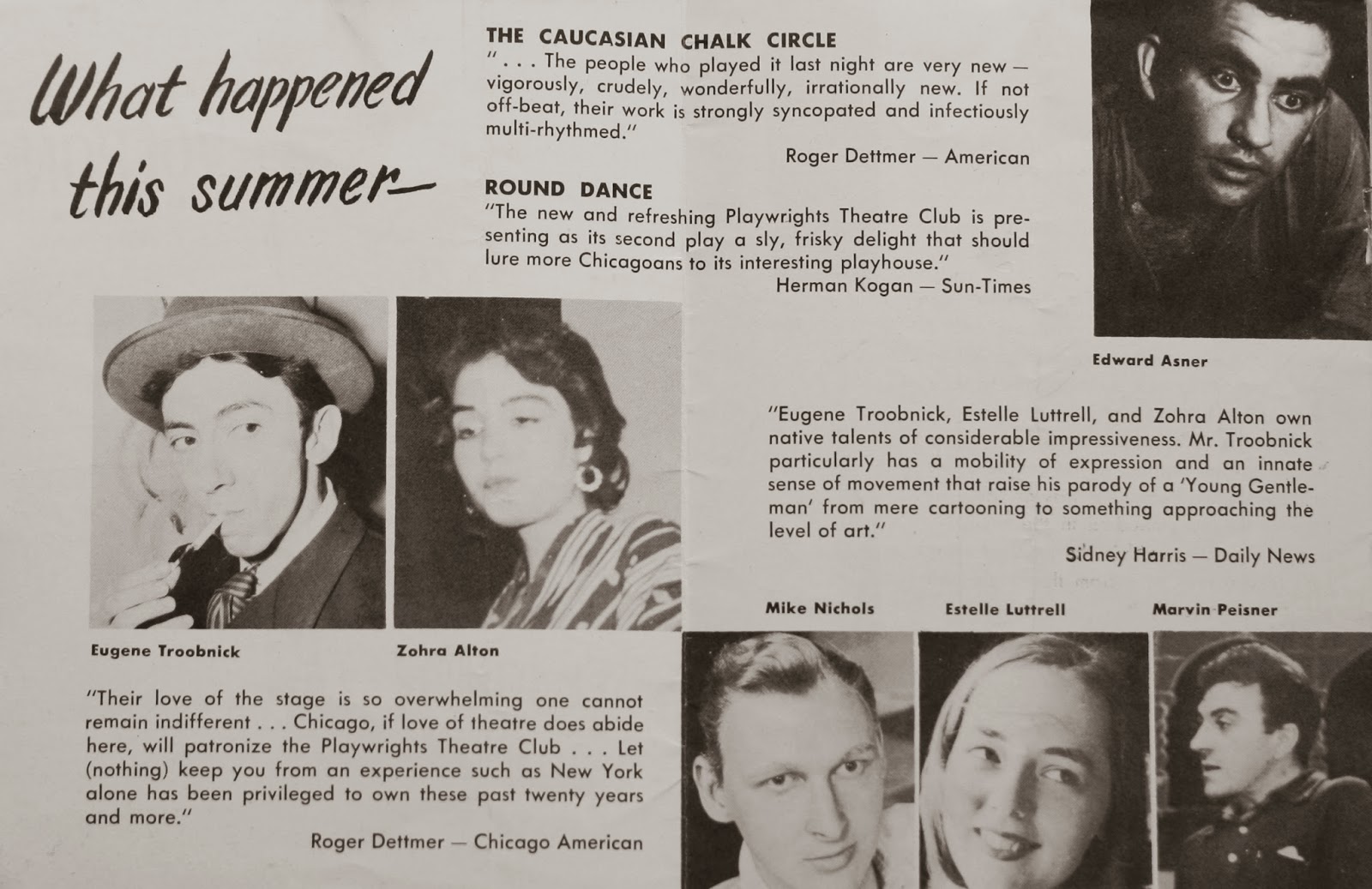
Playwrights Theatre Club brochure - 1953.
 

Jerry Stiller, Nancy Ponder & Alan Arkin at the St. Louis Compass, 1959.

These days, I’m trying to convince David Shepherd that a book of his vintage shots would be of enormous interest to the improv community.  Aside from the documentary, many have appeared in Jeffery Sweet’s Something Wonderful Right Away and Janet Coleman’s The Compass.  But believe me my improv brothers and sisters, there are scores of other pictures that have not been viewed by the public for many decades.  It’s time they found their way back into the light.


Michael Golding is a writer, director and improv teacher.  He can be contacted for workshops, festivals and private consultations at migaluch@yahoo.com. Michael participated in the evolution of the Improv Olympics & Canadian Improv Games. Artistic director of the Comic Strip Improv Group in New York & created the Insight Theatre Company for Planned Parenthood, Ottawa.  He is a faculty member at El Camino College in Los Angeles, working with at-risk teens and traditional students. His screenplay credits include "Celebrity Pet" for the Disney Channel and the documentary "David Shepherd: A Lifetime of Improvisational Theatre."  His book, Listen Harder, a collection of essays, curriculum and memorabilia on improvisation and educational theatre, is available on Amazon, Barnes & Noble and CreateSpace. Michael holds a BFA degree in Drama from New York University’s Tisch School of the Arts & an MA degree in Educational Theatre from NYU’s Steinhardt School of Culture, Education & Human Development.


Sunday, September 29, 2013

Letters to Dad by Michael Golding


My parents live in New York, and to this day they are still convinced that I moved three thousand miles just to get away from them.  Granted, I spent the first eighteen years of my life yearning for the day that I could move out of their house, but I always make sure that I call them at least once a week, twice, if I need money.  Despite my age, I am still the baby of the family and treated accordingly.  Normally, that doesn’t bother me, unless there is a family crisis where it takes a combination of information from my brothers, uncles, aunts and cousins to get the “real picture.”

A recent sonogram detected tumors in my father’s bladder, and a procedure was quickly scheduled.  Frustrated that I couldn’t make the trip back east for emotional support, I spent an uneasy three weeks downing enough coffee to wake the dead and reading volumes of information on bladder cancer.  According to my father, the procedure involves “an instrument going up the ying-yang for a reconnaissance mission.”  Translation:  A cystoscope is inserted into the bladder through the urethra to cut out the tumors and burn away the remaining cancer cells.  Regardless of where you get the information from, if you’re a man, your legs reflexively cross.

One day while grinding coffee beans (or was that my teeth?) the realization came to me that my father, a captain in the fire department for 28 years, is an integral part of my creative output.  I once wrote a TV pilot on the adjustment his house had to make when women were allowed on the force.  My father was an investor in my first off-Broadway play. A border-line homophobe, he was the inspiration for a screenplay based on his reaction when his gay older brother broke up with his long-term companion.

Financed by my father.

Staged reading of my screenplay, based on my father.


Unfortunately, inspiration sometimes comes with a heavy price, and throughout the years my father has casually undermined the majority of progress I’ve made in therapy.  He is fascinated by my occupation, and once queried “What will you do when you eventually run out of ideas?”  If any one else in the world posed that question to me, I would have responded with something lofty like “How can anyone run out of ideas in this ever-changing evolving world where every day is a new adventure?  I embrace life.  I am like a sponge.”

But, since this question came from my father I fixated on “eventually” (his tone suggested he was confident that the day would come).  Instead, I spent many sleepless nights wondering “What if he’s right? Did I peak when I was 22? Could this be why I haven’t come up with anything fresh recently?”  I turn to my wife for reassurance, but she’s gotten so good at feigning REM sleep it’s difficult to tell if she’s asleep or not. Pinching her nostrils shut doesn’t work anymore.

As a rule, I shield my father from most of my work. A stickler for proper grammar, he’s been known to rewrite my dialogue in the margins (“Dad, it’s a story about inner-city teenage drug addicts. They don’t speak the king’s English.”) and replace obscenities (“Michael, four letter words are the result of a poor imagination.”).  He assumes that any inappropriate behavior stems directly from my own life-experience.  Then, I get a reprimanding phone call from my mother: “What’s this I hear about you killing a childhood friend and covering it up to look like an accident?”

Lately, my self-discipline has waned.  Admittedly, part of it stems from being concerned over my father’s health, which makes it hard to crank out comedy.  The Golding family is not a demonstrative lot (a caustic comment goes a lot further than a compliment in my family) and I’ve been tormenting myself after each phone conversation for not saying “I love you” to him.

My mother and brothers do not get my humor, probably because it’s usually at their expense, but my father does.  So, after an extended period of procrastination, I started writing again – in a series of long letters to him.  Each epistle filled my day with creativity.  When I wasn’t working on the computer, I was formulating the letters in my head.  In restaurants, I jotted ideas down on napkins.  Hey, Dad – I’m a writer again!

The first letter came with information about his condition from the National Cancer Institute.  It opened with: “Dad, after reading through this information thoroughly three times, I am convinced that your condition is not heredity.”  The letter ended with a suggestion that he bring several cartons of cigarettes with him to the hospital for bribing nurses, orderlies and fellow patients.

The day before he was admitted to the hospital, I opened up my heart in a letter that expressed my profound remorse at not being able to be at his side when he regained consciousness after the procedure (and to remind him how he reneged on letting me borrow his car on the night of my high school prom.  No, no – I’m not bitter.  We made a very fetching couple in the back of the bus.)  As a special bonus, I wrote a monologue for him – to be performed if a sudden six-figure sale puts me on the red-eye to New York.

            FATHER:  Michael?  Is that you, my son?  Come closer.  It is you. I knew
            you would come.  Your loyalty is most gratifying.  You’ve always been my
            favorite son.  I’ll tell you a secret. I’ve lived vicariously through you your
            entire adult life. (beat)  It’s getting dark in here. Did you lower the lights?
            (beat)  I can’t feel my legs.  I’m not ready.  I have so much more to accomplish!
            I WANT TO LIVE!  OH DEAR GOD I WANT TO LIVE!
            (Realizing it’s time for Jeopardy, Michael turns on the TV and raises the
            volume to drown out his father’s cries.)

Fortunately, the procedure was successful, and the biopsy revealed the tumors to be benign.  On the phone with my father the next day, I was horrified to learn that he brought my letters to the hospital with him; they lifted his spirits and gave him a kick.  Surprisingly, the relatives and friends who came to visit did not feel the same way.  One aunt couldn’t finish the letter that began “Dad, it might be a good idea to send me a Christmas gift early this year.”

I’d been in a funk lately because I had no passion for what I was writing. Two weeks of writing a letter every day to my father has re-energized me more than therapy, a writer’s retreat or even a startling epiphany could accomplish.

On the downside, I suppose my mother will be calling me any day now with some choice words about my recent missives.  She shouldn’t be so cocky. I wonder how her health is holding up?

My father, Captain Gerard Golding NYFD.  Born August 30, 1924. Died October 7, 2013.


Originally published in Written By (the magazine of the Writers Guild of America, West) August 1999 Vol. 3 Issue 7 


Michael Golding is a writer, director and improv teacher.  He can be contacted for workshops, festivals and private consultations at migaluch@yahoo.com. Michael participated in the evolution of the Improv Olympics & Canadian Improv Games.  Artistic director of the Comic Strip Improv Group in N.Y. & created the Insight Theatre Company for Planned Parenthood, Ottawa.  He is a faculty member at El Camino College in Los Angeles, working with at-risk teens and traditional students. Michael holds a BFA degree in Drama from New York University’s Tisch School of the Arts & an MA degree in Educational Theatre from NYU’s Steinhardt School of Culture, Education & Human Development.


Monday, September 23, 2013

This Thing Could Write Itself by Michael Golding


Before moving to Los Angeles, I thought danger was riding the subway in Manhattan at three in the morning. Two days after the 1994 Northridge earthquake decimated my dwelling I was introduced to the world of mountain biking by my neighbor Ray, who sensed that my adrenaline level had reached a toxic peak. New Yorkers may be street smart, but that doesn’t adequately prepare you for stashing all your possessions in an eight-by-ten storage space and finding a new apartment within two weeks.  But, I digress.

Ray in front of our neighborhood bakery.

Over the ensuing months I learned the intricacies of mountain biking the only way I knew how – the hard way.  After each excursion, I would return home to my wife from the field of battle, bruised and humbled – but looking forward to my next outing. 

With Ray on one of my first rides.


It wasn’t just the release of endorphins that was so addicting; it was the camaraderie of being with a group of enthusiasts on a three to four hour adventure surrounded by scenery that left you breathless and rejuvenated.  Plus, you get to look like a super hero in your tight fitting bike outfit.

Author with his machine.

A major benefit of barreling down a technical, rocky single track, was that it kept my mind off my career.  Slow dancing with the Angel of Death can focus anyone - in the Angeles National Forest, you’re really bait on wheels.  A trek through the craggy San Gabriel Mountains often would clear my head when I hit a roadblock in a script I was working on.  But what was particularly refreshing was that I rode with people who were not writers, actors or directors.  Finally, I could relax and have real conversations.

When it became common knowledge to my posse that I was a writer, the pitching began.  “Dude, you should write a mountain bike movie.  No one has done it before,” was how one ride began, followed intermittently by “It’s Deliverance on mountain bikes.  Bunch of people go riding, the big one hits, and they have to fight their way out of the mountains.”

By the time we reached the halfway point in the trail, there was dissension among the gang.  “No, no, no. You have it wrong. It has to have a hook. How about, bunch of people go biking, when they come out of the canyon it’s 1865?”  Each biker would try to enhance the other’s idea – “What if, the bikers were all 13 years old – and they meet their great, great, great grandfathers?”  It was like a grandiose outdoor development meeting, without the name dropping. I knew I was in trouble when one cyclist turned to me and said “You know, this thing could write itself.”

Mountain bike chorus line.
 
As a favor to Ray, and because I found the story intriguing, I wrote an article about him and his new passion: – mountain bike racing. At the age of 44, with an actual authentic nemesis dogging him at every racing event, Ray completed the ’97 Bud Light Mountain Bike Challenge series as Point Leader in his age group - an impressive achievement. The article was a joy to write and provided me with the satisfaction of completing a job without dealing with producers, executives or agents. 

Checking out Ray's bike before his race.

Soon, I was getting calls from various biking extremists who heard about the “killer article” I wrote for Ray and proceeded to pitch their own stories to me.

LINDA: Drugged out and directionless in high school. Discovers mountain biking at the age of 30. Now 35, she races professionally and models sportswear for print ads. (Linda’s hook, is that she drives around in a battered old VW bus. Contact Mattel for toy VW bus merchandising rights.)

SHERMAN: Once attacked by a mountain lion, he now proudly wears the helmet that the animal bit down on as a badge of honor. (His hook:– Franchise for helmets imprinted by mountain lion teeth.)

HEATHER:  (AKA “Pirate) Blind in one eye, which screws up her depth perception. Airlifted out of canyons at least once a year. (Her hook – franchise for eye patch.  “Pirate” – get it?)

As I politely listen to these character biographies, I attempt to slip into the conversation that as a professional writer, I tend to get paid now and then. That’s usually when the conversation comes to an abrupt halt.

Turning on the computer to face the mocking blank screen once again, random thoughts and images begin to fill my head:  Hmm… characters based on Ray, Linda, Sherman and Heather. Go biking in a canyon. Heather crashes and has to be air lifted out. Then the big one hits. Sherman is attacked by a mountain lion.  Gang goes through hell to get back to civilization and discovers that it is now 1865 and they’re all suddenly 13 years old.

You know, this thing could write itself.


Michael Golding is a writer, director and improv teacher.  He can be contacted for workshops, festivals and private consultations at migaluch@yahoo.com. Michael participated in the evolution of the Improv Olympics & Canadian Improv Games.  Artistic director of the Comic Strip Improv Group in N.Y. & created the Insight Theatre Company for Planned Parenthood, Ottawa.  He is a faculty member at El Camino College in Los Angeles, working with at-risk teens and traditional students. Michael holds a BFA degree in Drama from New York University’s Tisch School of the Arts & an MA degree in Educational Theatre from NYU’s Steinhardt School of Culture, Education & Human Development.


The Insight Theatre Company by Michael Golding


2012  marked the 30th anniversary of the Insight Theatre Company, a touring teenage troupe that expresses the concerns, emotions and situations of themselves and their peers through improvised scenarios.  The troupe is sponsored by Planned Parenthood, Ottawa, and I was fortunate to direct and produce the first company for them.

At the time, I was working for Stage Fright, a local theatre company that was producing the Canadian Improv Games, a competitive improv format for teens, inspired by David Shepherd’s Improv Olympics.  Planned Parenthood, Ottawa, contacted Willie Wyllie, the head of Stage Fright, to attend a performance of the Youth Expression Theatre, a teenage troupe sponsored by Planned Parenthood, Boston.  The audience consisted of health officials, teenagers and teachers with the Carleton Board of Education. Willie invited me along.


Planned Parenthood, Ottawa, wanted to develop a similar program for teenagers.  At the time, I had no idea Willie had already chosen me to produce and direct the Ottawa company.  Therein lies the reality of my thirty-plus year friendship with Willie.  He allowed me the luxury of believing that I had freedom of choice, when in fact a decision had already been made on my behalf.  But, I digress.

I had never seen anything quite like the Youth Expression Theatre before.  The Boston teenagers, with an age range of 15 to 18, were edgy, acerbic, confident and had an element of danger about them.  The scenes were designed to increase awareness, provide information and encourage discussion of controversial subjects relevant to teenagers.  The scenes all had unresolved endings, so that the cast could engage the audience in a dialogue after the performance.

I was in awe of the intensity and candor of the actors during this portion.  Their accessibility made it easy for the teens in the audience to engage in hard-to-discuss topics.  There were two parts to this discussion, first with the cast in character, then as themselves.  They did not seek to offer judgment or present a particular point of view with these scenes.  One particular scenario involving a girl who brings her date home only to discover that her parents were not there, got the most questions.  She didn’t want to get involved sexually, but he did, becoming increasingly aggressive until he finally raped her.  The girl who played the assault victim said she had doubts about joining the troupe, because she’s Catholic and her family was disturbed by Planned Parenthood’s involvement.  After giving it some thought, she realized that the program’s educational input would prevent abortions.  There was a rousing round of applause at this statement.


What I learned afterwards, was that this type of show was a Theatre-In-Education (or T.I.E.), production – which is an umbrella term for a technique that utilizes all the elements of theatre as a teaching tool.  I eventually got my Master’s degree in this discipline at New York University.

My first concern was whether Ottawa teenagers could pull off a show like this.  At the time, I viewed Canadian teens as simply “nice” and wondered if they were capable of the honesty, courage and self-awareness needed for this type of production, whereas, my thinking about Boston teens was that they had the advantage of living in a city where controversial subjects were discussed openly.  Although teenagers in Ottawa experienced the same pains of adolescence as the Boston group, they displayed it on a more subtle level.

Willie and I contacted about forty teenagers in Ottawa, to be interviewed at the Planned Parenthood main office. All of them played in the Canadian Improv Games, so, from the start, a big plus was that I was going to work with teenagers who already had a strong foundation in improv.  At the interview, we broke the kids up into four groups.  Willie, myself and two Planned Parenthood officials led discussions on topics such as sex, school, drugs, and parents.  Afterwards, we compared notes, made suggestions as to who to call back, and eventually we had our troupe – sixteen members, which eventually shrank down to ten.

Cast with Jack Eyamie of Stage Fright (bearded gentleman) & director (mustache)

At the first workshop, I kept thinking to myself “God, these kids are so white!”  I assumed most came from middle to upper middle class families.  Turns out, many came from families close to the poverty level and had to work after school jobs to help out.  A few came from single parent families, or were living on their own with a relative or friend.

For the first few weeks, the girls would sit on one side of the room and the boys on the other.  As the discussion sessions became more personal and open, the boys were able to become more sensitive and aware of the needs of the girls, and vice-versa.  The mingling began.  After each rehearsal we would go out for coffee and talk about what transpired in the workshop.  I was trying to discover what these teens felt, what they needed, and what I discovered surprised me, and slowly destroyed my preconceived notions about Ottawa teenagers.

In intensive rehearsal sessions, theatre skills were integrated with education in the areas of teen concern.  I shifted their improv focus from comedy and exaggerated characters to realism, emotional sincerity, and approaching the scenes with an activity- based perspective, rather than a verbal one.  Applause was prohibited at rehearsals, to cut down on the temptation to entertain.  I had seen teams at the Canadian Improv Games present scenes dealing with issues such as dating and peer pressure before, but the depth potential was barely scratched.

In the beginning, my emphasis was on familiarizing the group with each other.  However, physical contact was very rare in scenes.  Whether it was out of nervousness, being self conscious, afraid of what the group might think, or what the other player in the scene might feel – there was resistance.  With Spolin’s game Contact, where a player has to touch the other in a different way every time they speak, it seemed like I was asking the teens to copulate in front of the group.  Another obstacle was that nobody wanted to play a character that might generate a negative reaction from the audience.  They wanted to come off as hip and amiable as possible.  Interestingly enough, when it came to playing parents, the kids’ roleplaying became extremely realistic – shouting, shoving and touching!

The warm-ups were designed to delve into personal beliefs and values.  Most effective were Tirades and Endorsements, a quick “soapbox rant” about what you’re passionate about in life and what makes you angry.  Best Thing/Worse Thing, a brief commentary on the best and worse thing that happened to you that day. What I Need/What I Don’t Need – was a great warm-up to generate empathy in the group.  Character Hot Seat, where a player is interviewed as someone they knew well, provided valuable information on the world the teenager lives in.  All of these exercises provided the springboard to explore various themes, issues and scenarios in scenes.  But, it was Spolin’s Activity that Describes Yourself game that became a watershed moment with the group.


In Activity that Describes Yourself, a player has to pantomime an activity that provides us with a glimpse into their life.  One by one, members did activities such as typing, playing sports, cooking, and reading.  Then one player, Sandi came up, sat down on the floor, created a knife and slowly sliced small cuts into both her arms.  There was giggling from the group at first, then the slow realization sank in that she was serious and the room became intensely quiet.  When she finished, the group immediately began to question her without waiting for me to facilitate a discussion.

Sandi was surprised by the reaction from the group.  She explained that when she “screws up” or doesn’t do well in school, she cuts herself as punishment.  Apparently, her sisters exhibit the same destructive behavior.  There was a moment when Sandi felt like she was being judged by the group, and started to regret participating in the game.  Then, the group proceeded to share examples of their own self-destructive behavior:  Warren smacks his head against the wall until he draws blood or passes out, whenever he loses a hockey match.  Celia sits in the snow wearing only a t-shirt and shorts until she can barely move whenever she doesn’t do well on a test.  Ralf gets on a bus destined for an unknown area with only enough money for one way when he gets turned down for a date.  Ann places her hand over a flame to see how long she can hold it before burning herself whenever her parents fight.

As the discussion continued, with one member after another revealing aspects of their personalities they had never talked openly about before, I realized that I had severely underestimated this group.  They were self-aware, coping daily with the painful transition from adolescence to adulthood – and they were all in this together.  This was the beginning of the family-like atmosphere of the group, complete with honesty and trust.

Various community and social service groups participated in workshops with the troupe: Our House Drug Rehabilitation Centre, Rape Crisis Centre, Child Development Centre, Gays of Ottawa, Family Planning Clinic, and Planned Parenthood, Ottawa.  For many of the parents of the kids, it was important to know that while Planned Parenthood sponsored Insight, the troupe was not a public relations tool for the organization.  I was shocked by the misconception the public had about Planned Parenthood and frequently had to remind people that the organization was not against pregnancies, but rather unwanted pregnancies.  Also, family planning was just part of the services Planned Parenthood provided.  Again, this was thirty years ago, although, there are days when it seems like not much has changed with the public’s conception, if you forgive the pun.

After each presentation, we would brainstorm scenes, and then start improvising.  The method used to develop scenes I learned from David Shepherd and Paul Sills, who constructed scenes for Compass, the first professional improv company in the United States, in this manner:  As the players started improvising, I would write down important “beats” in the scene, which is any significant change in action or an important piece of dialogue.  Once a beat outline was finalized, the goal was in cutting the length down to the point where it was as sharp as possible.  This proved most effective when certain cast members couldn’t attend a performance.  All their replacement had to do was look at the beat outline and they were set.

Insight beat outline.
As the show came together, the issues we were dramatizing included drug and alcohol abuse, difficulties in communicating with parents and peers, homosexuality, acquaintance rape, depression, stereotypes and teen pregnancy.  As heavy as this may sound, there was a great deal of humor in the shows, which always came from the reality of the situation and characters.

Aside from the workshops, it was up to every cast member to do outside research.  Some developed relationships with the organizations who participated in our workshops.  Others interviewed runaways, drug addicts and teen parents.  Most of the situations we dramatized were not necessarily ones which the actors had experienced personally in real life, but there was one notable exception.

Marni, a 18 year-old cast member, had been sexually assaulted at a costume party by the father of her best friend.  The Planned Parenthood associate on the show and I helped Marni with getting in touch with counselors at the Rape Crisis Centre and filed a “fourth person report” with the RCMP.  Marni did not want to file charges, but if the father assaulted another underage girl, Marni’s report could be used as evidence against him. 

Few weeks later, Marni stayed behind after a rehearsal and we started talking about the assault.  She was still very much in the mindset that somehow she was responsible for the attack, based on the outfit she was wearing at the party, and how devastated her friend would be when the news got out about her father.  I asked Marni if she would be willing to explore the before, during and after events of the incident through a series of monologues.  Not for the show, but to help Marni cope with the experience.

Over the course of the next few weeks we worked on the monologues together privately, and the experience helped Marni cope with the assault, and more importantly, accept that it was not her fault.  The process of working on the monologues empowered Marni to the point where she insisted that it be included in the show.  It became one of the most powerful moments in the show, and there were easily scores of young women who came up to Marni after the show over the course of the tour admitting that they had a similar experience.  At the end of every performance, we handed out a sheet with contact information for all the organizations that participated in the production, and Marni made sure each and every girl knew where to go to get help.  Months later, the man who attacked Marni assaulted another young girl, who did file charges.  Marni’s fourth person report was used as additional evidence, and he was convicted.

It was not unusual that audience members came up to share experiences with the cast that they had previously kept private, was not unusual.  Every cast member became an ambassador for the organizations involved in the show.  As the tour progressed, the content of the show became richer, more complex and instantly identifiable regardless of the audience we were performing for.  Audience input during the discussion section would change the direction and content of certain scenes for future performances.  When we had time, occasionally we would replay scenes on the spot, incorporating the audiences’ suggestions, then go back to the discussion, focusing on the new approach. 

A scene I wish I could have included in the show came out of an improv after Jim, the head of Gays of Ottawa, conducted a workshop for us.  He had recently left his wife for a man, and was dreading telling his two children that he was divorcing their mother and admitting he was gay.  I suggested that he could practice telling his kids, by roleplaying the situation with two of my players.  Intrigued, he agreed.  In the scene, he carefully laid out why he was leaving their mother, that it had nothing to do with them and he was gay.  Grant, who played his son asked “But, you still love us, right?”  Jim replied “Of course.” Patti, who played his daughter asked “Do you love this man and does he make you happy?  Jim answered “Yes.”  The scene ended with the kids telling Jim that they loved him too and were happy for him.  It was one of the most moving scenes I have ever seen in a workshop.

Couple of days later, Jim called me in tears.  He had the talk with his kids and amazingly, it went exactly the way it was played out in the workshop.  I asked if he would be willing to give me permission to use the scene in the show.  After some thought he decided it was too personal and I respected his decision.  But, damn – I wanted to use that scene!  In retrospect, I should had prodded him further – reasoning that it could inspire other people to come out.

The troupe toured for 6 months, performing for community centers, high schools, social service agencies and guest spots on local television shows.   The troupe quickly became a close-knit group, socializing and at times, dating.  Rehearsing scenes away from the workshop was encouraged.  Sometimes, when I felt a scene was starting to get stale I would recast it right before a performance, to give it a fresh surge of spontaneity.


I became extremely close to the cast.  Their parents viewed me as a father figure. To the cast, I was a slightly older version of them.  Willie and I were roommates, and frequently we had a cast member as a houseguest.  Most cases, it was just to hang with us for the weekend and help out with administrative work needed for Insight or the Canadian Improv Games.  But, we had one long term guest.  Patti’s father suddenly died of a heart attack while jogging with her mother.   Patti was emotionally shattered and was ready to leave the troupe and high school, and “hit the road” because the grief with her large family was unbearable.  We allowed her to live with us on the condition that she remained in high school, the troupe, and more importantly – take charge of the housecleaning.  This arrangement worked quite well.  Our apartment never looked better.

4 1/2 Henry Street Ottawa, home to wayward improvisers.
 
One day when I had to go down to New York to see the opening of a friend's play, Warren offered up his mother's car.  One catch.  Warren, Ann, Patti and Ralf were part of the package.  I had a catch too, which wasn't revealed until we arrived in New York.  Ralf and Warren stayed at my parent's house.  Anne and Patti stayed at a friend's place.  All seemed surprised by this arrangement.  Nice try, kids.  For the record, no cast member became a parent on my watch.

My role slowly changed from director, to confidante of the group.  If any member of the group had problems with school, parents, boyfriends or girlfriends, inevitably, they came to me.  I appreciated their openness and honesty, but had to be careful with how I would use this knowledge – particularly in rehearsal.  In cases where I would, it was always in private and to provide them with a frame of reference if the content of a scene wasn’t clicking.  I call this technique “Spolin meets Strasberg.”   As for my original impression that these were lily-white teenagers with privileged lives, that was finally put to rest when we did a workshop on runaways.  Sandi admitted she ran away from home at 15 to Newfoundland, where she worked as a prostitute for close to two years and finally returned home after she was gang-raped and left for dead.

The Insight Theatre Company garnered a great deal of press and we were suddenly thrust into the celebrity spotlight when Platform, a current events television show, wanted to do a one hour adaptation of the show.  During preproduction, several unexpected problems arose.  First, ACTRA (Association of Canadian TV and Radio Artists), felt the cast weren’t amateurs, based on the professional level of their performances.  I suppose it was a compliment, but we didn’t have the $10,000 on hand to make every member part of the union.  Howard Jerome, one of the founders of the Canadian Improv Games made a passionate plea on our behalf, and ACTRA changed their decision and granted us waivers to appear on the program.


Next, the producers of the show were uncomfortable with a scene between two brothers where one admits to the other that he was gay.  Since this was an early morning show, the producers felt the scene might be offensive to some viewers.  When I suggested, as a joke, that I could change it to two sisters instead, the producers thought that was acceptable, and that’s the way the scene was presented in the broadcast.  Finally, because of the three camera set-up, the cast couldn’t be as physical as they were in the stage show.  So, the scenes either had the actors standing and talking, or sitting and talking.  The end result came off a little more heavy handed in tone than the stage show, but was still effective.  The broadcast got high ratings, was repeated a few times, and led to the creation of a four episode series called “Crisis Theatre” which was essentially Insight for adults.

Three decades later, I’m still in touch with many of the troupe members.  A few have become life-long friends.  Others, I’ve recently re-connected with through the magic of Facebook.  Most are parents with teenagers of their own.  When their kids complain they don’t understand them or have forgotten what it’s like to be a teenager, they throw on the Platform television show, stand back and silently observe their minds being blown.


Michael Golding is a writer, director and improv teacher.  He can be contacted for workshops, festivals and private consultations at migaluch@yahoo.com. Michael participated in the evolution of the Improv Olympics & Canadian Improv Games.  Artistic director of the Comic Strip Improv Group in N.Y. & created the Insight Theatre Company for Planned Parenthood, Ottawa.  He is a faculty member at El Camino College in Los Angeles, working with at-risk teens and traditional students. Michael holds a BFA degree in Drama from New York University’s Tisch School of the Arts & an MA degree in Educational Theatre from NYU’s Steinhardt School of Culture, Education & Human Development.