Showing posts with label Mike Fly. Show all posts

Sunday, February 3, 2019

David Shepherd and the ImprovBoston Festival by Michael Golding


My close friend and mentor for 46 years, David Shepherd, the father of improvisation, passed away on December 17, 2018. He was 94 years old. With Paul Sills, David created Compass (1955), the first professional improv cabaret in North America and forerunner of Second City (1959). With Howard Jerome, David created the Improv Olympics (1972) which inspired the Canadian Improv Games (1977, created by Howard Jerome and Willie Wyllie) and i.O. (1981, founded by Charna Halpern and Del Close). In 1998, David brought MOVIExperience, his improvising movies with nonprofessionals format to Pioneer Valley, Massachusetts. Nancy Fletcher, one of the MOVIExperience participants, believed the format could be used to build confidence and character in adolescent girls and founded Act Now! (2000). David's last format was Life-Play (2009), improv games designed to be played over the phone. 
David Shepherd & Michael Golding
David Shepherd suffered from manic depression most of his adult life. His wild mood swings were at times terrifying for me in my early teens. Paul Sills had a gift for being able to diffuse David’s temper and I’d like to think that I learned from the best. I felt the two were polar opposites when it came to temperament, which is why I was surprised to learn in Jeffrey Sweet’s “Something Wonderful Right Away” that Paul had a formidable temper of his own. I remember thinking “I know not this Paul Sills people are talking about.” Paul was always warm, funny and supportive in the workshops I took with him. He never threw a chair at me (not even an imaginary one), which was a recurring memory from the founding members of Playwrights Theatre Club, Compass and Second City.       

Through David’s association with ImprovBoston, we had arranged for his documentary “David Shepherd: A Lifetime of Improvisational Theatre” to be screened at their annual festival in 2011. It would include a Q & A session with me, David, Howard Jerome and Nancy Fletcher and a workshop demonstration of Life-Play, David’s latest format.  I agreed to fly to Belchertown from Los Angeles so that I could drive with David and Nancy to the event.

When I arrived in Belchertown, David surprised me with the news that he planned on showing an instructional Life-Play video after the screening, aiming towards selling copies to the audience. I told him that was not the agreement with the festival and Life-Play was already represented quite well in the documentary.  David was not pleased with that answer and wanted me to approach the festival about changing the program.

By nightfall Howard arrived from Toronto. I had heard back from the festival. We were going to stick to the original plan. David was incensed, ranting about how hard he worked on the videos. Willie Wyllie, the executive producer of the documentary called David from Ottawa (responding to my S.O.S. text) hoping to reason with him. The work on the videos wasn’t wasted. He just couldn’t show or sell them at the screening. The focus was on the documentary and the fine work of our director, Mike Fly and writer, (me). David had an enormous amount of respect for Willie, who could always be counted on to give the final word he would accept. Willie was successful once again.

Howard and I agreed to look at the video so that David could get our feedback. It was dreadful. Poorly lit, bad editing and hard to follow. Not the best representation of David’s work and we told him that. His cork popped; “Fuck it! I’m getting too old for this shit! I can’t do this anymore, schlepping from place to place trying to get gigs and selling my formats!”  Of course, none of this was the case with the festival, where he was to be honored.  Maybe he couldn’t accept that even though the documentary was about him, it wasn’t his project and he needed to focus on something where he had some control. To David, the documentary represented the past, Life-Play, the present and future. So that evening the three of us in an instant went from a loving reunion to a lot of yelling and “fuck you!”

Next morning, I greeted David with my usual “Good morning, Mr. Shepherd. How are we today?” David somberly replied, “I can’t wait for this day to be over.” I laughed; “Atta boy. That’s the spirit.” My approach whenever David was in the dark zone was to treat his every response with optimism, love and humor.  Howard was already on his way to Boston to catch some shows before our screening.

Once we were in the car and on the road, (me at the wheel, David in the passenger seat and Nancy in the back), he relaxed considerably. Road trips were a big part of our relationship and we seamlessly eased into our travel banter – improv, expanding Life-Play, future projects, my work with at-risk populations. We picked up lunch from MacDonald’s on the way, and David slowly fed me French fries one at a time as I drove.  I loved that. When we arrived in Boston, David was wide-eyed. It had been a while since he’s been there and was fascinated by the architecture and people. By the time we arrived at the theatre, David was in a playful, joyful mood.

Well, that quickly ended as the audience entered for the screening. The event wasn’t well publicized and there were about 25 people in the audience. David glared at me and I could see that he was ready to determine that the screening was going to be a humiliating failure for him.  Just then, a young woman sitting behind David started talking about how excited she was to see the documentary. She had driven with friends from Rhode Island, was currently reading The Compass by Janet Coleman (who was also in the documentary) and was hoping that she could get to meet David Shepherd.  I turned around and said, “Are you aware that the father of improvisation is sitting right in front of you?” She exploded with excitement. A sly smile appeared on David’s face as she showered him with appreciation. After they talked a bit, David turned around and the house lights started to dim. I leaned over to David and whispered, “that didn’t suck, did it?”  “No. It did not.” He patted my knee affectionately.

This was the third time I had watched the documentary from start to finish with David and he’s always totally engrossed. I could only imagine what memories sparked inside him with every viewing.  The audience while small, was extremely responsive.  As the end credits rolled, David whispered, “that was excellent.” His standard response, always with a tinge of amazement in it.  I was happy to see Carman Dewees at the screening. He, along with Chris Britt, developed Life-Play with David. Carman and David had a falling out due to David’s unreasonable demands (a constant with partners David has collaborated with over the years) and had not spoken for some time.  David was sincerely pleased to see Carman and the two had a warm, brief reconciliation.  After they spoke, David confided in me that he accepted full responsibility for Carman leaving Life-Play. Carman was solely responsible for the launch and initial success of Life-Play, recruiting players, setting up conference calls and putting together a polished handbook of the format’s games with essays from me, David, Howard and himself. David realized he had let a gem slip through his fingers.

The Q & A portion went well, as did the Life-Play demonstration, which I conducted with volunteers from the audience. David and Howard side-coached some of the games. Originally scheduled for ten minutes, I ended up doing a half hour because it was going so well. Jeremiah Jordan, the artistic director of the festival who was watching from the side gave me the okay. When it was over, we had to quickly leave the theatre for the next event to set up. The audience followed us out into the lobby, enveloping David with attention, then outside the theatre, then joined us for dinner at a restaurant down the block.  David was energized, talking improv and meeting new people. 
Q&A moderated by Jeremiah Jordan with Michael Golding, Nancy Fletcher, David Shepherd and Howard Jerome.


Setting up Life-Play guidelines with two volunteers.

David Shepherd and Howard Jerome side-coach two volunteers playing a Life-Play game.

Driving home, I fielded calls from Mike Fly and Willie Wyllie.  It was a ninety-minute drive and I was pushing the speed a bit. With David holding the phone to my ear and Willie draining me for every detail, I tell my improv brother that “the life of the father of improvisation is in my hands right now so maybe I should focus on my driving.” For the rest of the drive, we talked about all the new people we met at the screening and how David was going to recruit them for future projects. He had given out all his business cards. He was happy.   

Back at the house, Nancy goes immediately to bed and David and I stay up for a while, sharing a joint. Yes, I was smoking with an 87-year old man. It was a long active day. Navigating David’s emotional minefields can be draining, but now I was getting stoned, playful, fun, David. It made the day worthwhile for me.

After we say our goodnights I walk towards my room. David sings out “Michael!”

“Yes, David?”

“You’re an excellent workshop director.”

“Thank you, David. I had a great teacher.”

“Thank you.”

For a moment I thought about screwing around with him by adding “Oh, you thought I meant you?” But it would have ruined a perfect moment. And it would have been a lie.

Next morning David wanted to know when we were going on our next road trip.

David Shepherd, Michael Golding, Howard Jerome and Nancy Fletcher at ImprovBoston, 2011.

Michael Golding is a writer, director and improv teacher. He can be contacted for workshops, festivals and private consultations at migaluch@yahoo.com.  Michael participated in the evolution of the Improv Olympics and Canadian Improv Games. Artistic director of the Comic Strip Improv Group in N.Y. and created the Insight Theatre Company for Planned Parenthood, Ottawa. He is a faculty member at El Camino College in Los Angeles, working with at-risk teens and traditional students. He wrote and co-produced the documentary "David Shepherd: A Lifetime of Improvisational Theatre" (available for free on YouTube). His book, "Listen Harder," a collection of essays, curriculum and memorabilia on improvisation and educational theatre is available on Amazon, Barnes & Noble and CreateSpace. Michael holds a BFA degree in Drama from New York University's Tisch School of the Arts and an MA degree in Educational Theatre from NYU's Steinhardt School of Culture, Education and Human Development.   


Sunday, February 23, 2014

Improvising over Lunch by Michael Golding


"The development of the games for improvisation are benign.  They are healthy. They are therapeutic. They are what we should all be doing. When you play, you do it with somebody else, which brings you, hopefully, closer to the other person.”  David Shepherd – 1999.

During the late spring of 2010, Willie Wyllie and I made a pilgrimage to David Shepherd’s home in Belchertown, Massachusetts, to attend a celebration of the 10th anniversary of ACT NOW! in nearby Amherst.  Inspired by David Shepherd’s format MoviExperience, ACT NOW! is a nonprofit organization created by Nancy Fletcher, which builds confidence, leadership, collaboration and character in adolescent girls through the process of developing and shooting an improvised movie.  Included in the celebration, was a preview of two segments from the recently completed documentary, “David Shepherd: A Lifetime of Improvisational Theatre,” directed by Mike Fly, written by me and executive produced by Willie Wyllie.

Willie co-created the Canadian Improv Games (CIG) with Howard Jerome and is the organization’s CEO.  Inspired by David Shepherd’s Improv Olympics, CIG is a nation-wide program involving over 300 high schools and more than 200 volunteers who produce 100 nights of performances featuring 3,000 students. It culminates in a week long festival at the National Arts Centre in Ottawa. I have known Willie for over thirty five years, shared many adventures with him, and we are as close as brothers.


Unfortunately, Willie was at the precipice of a new chapter in his life.  As the result of health issues, he had to step down as a partner at one of Canada’s top law firms.  Unable to travel alone, I had to rendezvous with him in Ottawa, so that we could drive down to the states together for the celebration, accompanied by his portable oxygen machine – which turned out to be a great upper body work-out for me.

When I arrived in Ottawa, I expected to find Willie depressed by the change of course his life had taken.  Instead, I found the same old Willie; self-effacing, playful, and sardonic - with a penchant for putting me into situations that test my stamina and mental health.  We kept the conversation light during our long drive, primarily because Willie slept through most of the eight hours it took us to get to Belchertown. Every attempt I made to get into his head regarding his health was tactfully brushed aside as Willie fell back to sleep.  Even a sudden tornado warning, followed by torrential, apocalyptic rain with heavy winds could not rouse him from his slumber.  Bastard. I say that with love.  He was curious when he noticed the impression my hands made gripping the steering wheel and why I kept repeating “This is the Emergency Broadcast system. This is NOT a test. Repeat.  This is NOT a test.”  
  
The celebration was a success. Willie and I were pleased by the enthusiastic reaction the clips from the documentary received.  David Shepherd was in the process of overhauling his latest format, Life-Play and wanted our input.  Created by David, Carman Dewees and Chris Britt, Life-Play was designed as a series of theatre games to be played over the phone.  Several podcasts were produced, utilizing a variety of Life-Play games. Entertaining to listen to, yet David felt something was missing.  The three of us agreed to have lunch together the next day to brainstorm.

That night, Willie and I were up until dawn hammering out different ways to approach Life-Play.  Willie’s sleep cycle is unlike that of us mere mortals.  He can stay up for days, while being perfectly alert and cogent.  This is usually followed by being unconscious for days.  I now refer to this as “Willie’s hibernation cycle.”   By the time rays of sun beamed through the windows of the inn we were sharing, I was begging him to allow me to finally sleep.  He reluctantly acquiesced, then worked on the format for a few more hours.

Refreshed by two and a half hours of sleep, I awoke at 8:30am to discover Willie sitting in a chair with a bowl of cereal on his lap, wondering if I was going to spend the entire day in bed.  As we drove to David’s house to pick him up for lunch, we agreed that if the essence of Life-Play is about exploring one’s life, then the improv coach (known as “the guide” in Life-Play) must gain as much information from a player about their life before commencing.

At a Chinese restaurant in Amherst, David wasted no time cross-examining Willie with questions that have been on my mind from the start of our trip; “Why did you retire?  How do you feel about it? How do you envision your future?”  Willie was honest and open with David.  “I felt that I couldn’t compete, anymore.”  This admission was followed by fifteen minutes of Willie addressing David’s other questions.  I was hanging on his every word.

When it came time to discuss Life-Play, I asked David if we could demonstrate the refinements that Willie and I were talking about, rather than tell him.  Of course, David was up for that.  Turning to Willie, I asked if he was willing to play, with me as his guide.  To my surprise, he said yes.  I decided to start with Repetition Poem, where a player is given an emotion and a repetition line for his poem.  What stuck out to me when Willie was telling David about his situation was how he kept going back to “I couldn’t compete, anymore.”  So, the repetition line I pitched to Willie was “I can’t compete, anymore,” tempered by resignation as his emotion.

By the end of his poem, David and I learned a lot about what led up to Willie’s decision to retire.  Because he was no longer at the top of his game in negotiating and drafting complex legal contracts, Willie felt he was letting his partners, clients and firm down.  On top of that, he felt that he was living on borrowed time. With each breath of “I can’t compete, anymore,” Willie’s defenses dropped incrementally.

Surprisingly, Willie was up for another game – again, with me as his guide.  I chose Zoom Story, where the player is given an opening line as a springboard for a story.  During the course of the story, the guide can direct the player to “zoom in” on object, feeling, environment and action – while continuing the story.  Since Willie’s Repetition Poem ended with him doubting that he would be around much longer, I decided to set the story twenty years in the future.  The opening line I pitched was “I was sitting in my chair.”

By this time, the lunch crowd was gone from the restaurant, and it was just the three of us.  In his Zoom Story, Willie envisioned himself as a withered, infirm man.  His youngest son Joel comes for a visit and Willie is thrilled to see him.  He attempts to get out of the chair to greet him, but his arms can’t support his body.  Joel anticipates this, and rushes over, embracing Willie, so he doesn’t have to struggle. By guiding him through the changes of emotion, object, environment and action, David and I felt Willie’s frustration with his failing limbs, the scent of the chair he spends most of his time in, how his clothes felt on his body, his exaltation upon Joel’s appearance, and the comfort his son’s embrace gave him.  Despite his physical state, Willie was able to revel in the emotions of joy, pride and love.


When Willie finished his Zoom Story, I asked why he chose Joel out of his three children as the one who visits. “Because Joel is mini-me.”  Then, Willie told us a story we never heard before.  Years ago, Willie’s lung capacity dropped to a life-threatening level and he had to be put into an induced coma.  Things went from bad to worse when his physicians couldn’t get him out of it, and a couple of months later, it seemed like Willie would not survive.  His wife, Sandra, was told by the doctors that Willie had only 24 hours or less to live. Two hours later, Sandra found out she was pregnant with Joel.  Miraculously, Willie woke up from his coma after having a dream about attempting to board a train, with the conductor turning him away because “it wasn’t his time.”  Opening his eyes, Willie saw two framed pictures next to his bed.  One was a picture of Sandra with their two children, Bethany and Ben.  The other was a silhouette of a child with the phrase “Coming soon.” In his opiate caused stupor, it took hours for Willie to realize it wasn’t a movie that was coming soon.

My last observation about Willie’s Zoom Story almost became a bone to pick, with me.  “Let me understand something.  You have yourself on death’s doorstep with your Repetition Poem.  I give you hope by adding another twenty years with Zoom Story, and you undercut it by being infirm. What’s up with that?”  Willie counted off his various conditions, which included severe fatigue due to leukemia and severe chronic nerve pain (the result of his near death experience 12 years earlier).   He was being realistic.

Just then, Walt, David’s 74 year old friend dropped by with his wife to say hi.   Walt apologized for missing the impromptu improv cabaret party we had thrown at David’s house the other night, because he was too ill after a chemo treatment.  Willie was surprised by this, because Walt is a strong, vibrant man who appears to be the epitome of good health. “If you don’t mind me asking, what do you need chemo for?”  Smiling, Walt responds “Lung cancer. Twenty years ago my doctors gave me five years.”  Willie is intrigued. “What do you attribute beating the odds to?”  Walt points to his wife. “This woman. No treatment is off the table.  Every once in a while I need chemo, I get sick, then, it’s business as usual.”  Willie didn’t say anything after that, but I knew the wheels were turning. Call it serendipity, coincidence or just plain stupid luck. I am grateful Walt showed up when he did.

As we left the restaurant, Willie admits that was the first time he had improvised in twenty years. “Why did you decide to play, today?”  With a matter of fact tone, Willie replied, “Because I trust you.”  My cell rang as I opened the car door.  It’s my wife, Jody, calling from our home in Los Angeles. She was just in a car accident, the adrenaline rush had worn off and she needed to hear her husband’s voice.  As I comforted Jody, Willie took the car keys out of my hand and opened the back seat door for me.  I slid in; Willie got behind the wheel and David got in the passenger seat next to him.  Off we went.  Apparently, my job as a guide was not done for the day, yet.

Epilogue:  Willie went into a 36 hour hibernation cycle that night, where no force of nature could wake him. I was beside myself with worry. When he finally awoke, he was ready for the next leg of our trip, which was New York – and was wondering why I looked so stressed.  The last thing I said to David before we left was “David, you were there at the beginning of my friendship with Willie, and now you can say you were there at the end as well.”

I could see David laughing in my rear view mirror as we pulled out of his driveway.

Hanging after Act Now! celebration.  Left to right; Howard Jerome, David Shepherd, Michael Golding & Willie Wyllie.
Willie Wyllie, Michael Golding & Nancy Fletcher, founder of Act Now!


Life-Play handbook. 
http://www.slideshare.net/cdewees/life-play-ehandbook

ACT NOW!
http://www.actnow-online.org/

Canadian Improv Games
http://improv.ca 


Michael Golding is a writer, director and improv teacher.  He can be contacted for workshops, festivals and private consultations at migaluch@yahoo.com. Michael participated in the evolution of the Improv Olympics & Canadian Improv Games. Artistic director of the Comic Strip Improv Group in N.Y. & created the Insight Theatre Company for Planned Parenthood, Ottawa.  He is a faculty member at El Camino College in Los Angeles, working with at-risk teens and traditional students. He wrote and co-produced the documentary "David Shepherd: A Lifetime of Improvisational Theatre" (available for free on YouTube).  His book, Listen Harder, a collection of essays, curriculum and memorabilia on improvisation and educational theatre, is available on Amazon, Barnes & Noble and CreateSpace. Michael holds a BFA degree in Drama from New York University’s Tisch School of the Arts & an MA degree in Educational Theatre from NYU’s Steinhardt School of Culture, Education & Human Development. 


Tuesday, October 1, 2013

The Improv Archives by Michael Golding


Somehow, I’ve become the improv archivist.   Always had a healthy stash of vintage memorabilia, as a result of my friendship with David Shepherd.  The basement of his country house in Armonk, New York, was a shrine to Compass; posters, flyers, scenario plays, press articles and pictures, neatly preserved in albums and file folders.  Unfortunately, a flood in the early 1980s took out nearly a third of his collection, including some reel-to-reel recordings of Compass.

  
Shortly after the 2009 Canadian Improv Games National Festival (inspired by David’s Improv Olympics), Willie Wyllie, co-founder of the format, recruited me and Mike Fly, an improviser and filmmaker from Toronto (Sexy Nerd Girl, Versus Valerie and Space Janitors) to shoot a series of interviews with David on his fifty-plus year career in improv.  Originally intended as a web series, Mike Fly had a vision that resulted in us making a full-length documentary, much to the chagrin of Willie, who was financing the project.  I don’t think I’ve ever worked with a director who was more confident, versatile and innovative than Mike, which is why I was surprised when he confessed one night that this was his first feature-length project.

Mike Fly and I spent four days filming David at his home in Belchertown, Massachusetts.  When it came time to get digital shots of his pictures, I was shocked when David came out of his office with a box, and dumped the contents onto the floor.   Gone were the days of his meticulous file keeping system. Mike set up the borders for the pictures, and one by one I handed him a photo to be digitized.  This process took us close to two hours - six, if Mike didn’t stop me from commenting on every shot (“Holy shit! Do you know what this is? It’s the holy grail of improv pictures!”).

Compass cast: Severn Darden, Larry Arrick, Elaine May, Shelley Berman, Mike Nichols, Rose Arrick & Barbara Harris - 1955.
Back home in Los Angeles, I plowed through the pictures on my laptop that Mike emailed me from Toronto.  We categorized them into files (Playwrights Theatre Club, Compass, Second City, Improv Olympics, etc.).  The largest was our miscellaneous file - great shots, but not relevant for the documentary. 

Little known Shepherd format.  Unfortunately, not enough material to cover in documentary. 

Despite the vast collection David gave us, there were still gaps in the timeline.  We managed to fill some of those in with pictures from the archive department at the University of Chicago.  David had donated a great deal of his memorabilia to the university.  I procured several discs from the department, which included a healthy selection of shots from the early days of Second City.  Again, many were not relevant for the documentary, but still spectacular in terms of improv history.  Those found a special home in my laptop.

Robert Klein & Fred Willard, Second City 1965
I started scouring the internet for pictures I knew existed, but weren’t in David’s or the University of Chicago’s collection.  Image search from Google and Bing were helpful, but the biggest finds came from magazine and newspaper articles from the late 1950s and early 1960s.  Maybe one or two found their way into the documentary.  Others, yep, express lane into my laptop.

Paul Sand, Severn Darden & Melinda Dillon in an ad selling advertising to liquor companies.

Shortly after we made the documentary available on YouTube, I realized that the hundreds of pictures nestling in my laptop weren’t doing anyone any good by remaining there.  So, I decided to share them with the improv community, mostly through various Facebook improv pages.  The response was immediate, unexpected and gratifying.

Alan Arkin, Paul Sills and Anthony Holland at Second City, 1961
First person I heard from was Aretha Sills, who told me that her father Paul was not great at holding onto things from the early days.  So, it was a pleasure to send her shots from Playwrights Theatre Club and Compass.  Sheldon Patinkin, with his incredible memory, was able to recall touching, personal anecdotes that provided a wonderful background to the pictures I was posting on a Chicago Theatre site.  A group picture from Jo Forsberg’s Player’s Workshop evoked a warm memory from George Wendt about an improviser he was enamored with. 

George Wendt in Jo Forsberg's Player's workshop - 1973
When Bernie Sahlins passed away earlier in the year, I realized that I had a picture of him from my miscellaneous file in front of Second City on their opening night in 1959.  That became the most re-posted photo from my collection on Facebook.
Bernie Sahlins

Soon, people were coming to me with requests.  Charna Halpern was moving i.O. to a different location in Chicago. Did I have any unique shots of Del Close? Yes, I do. 
 
Joan Rivers & Del Close at Second City, 1961.


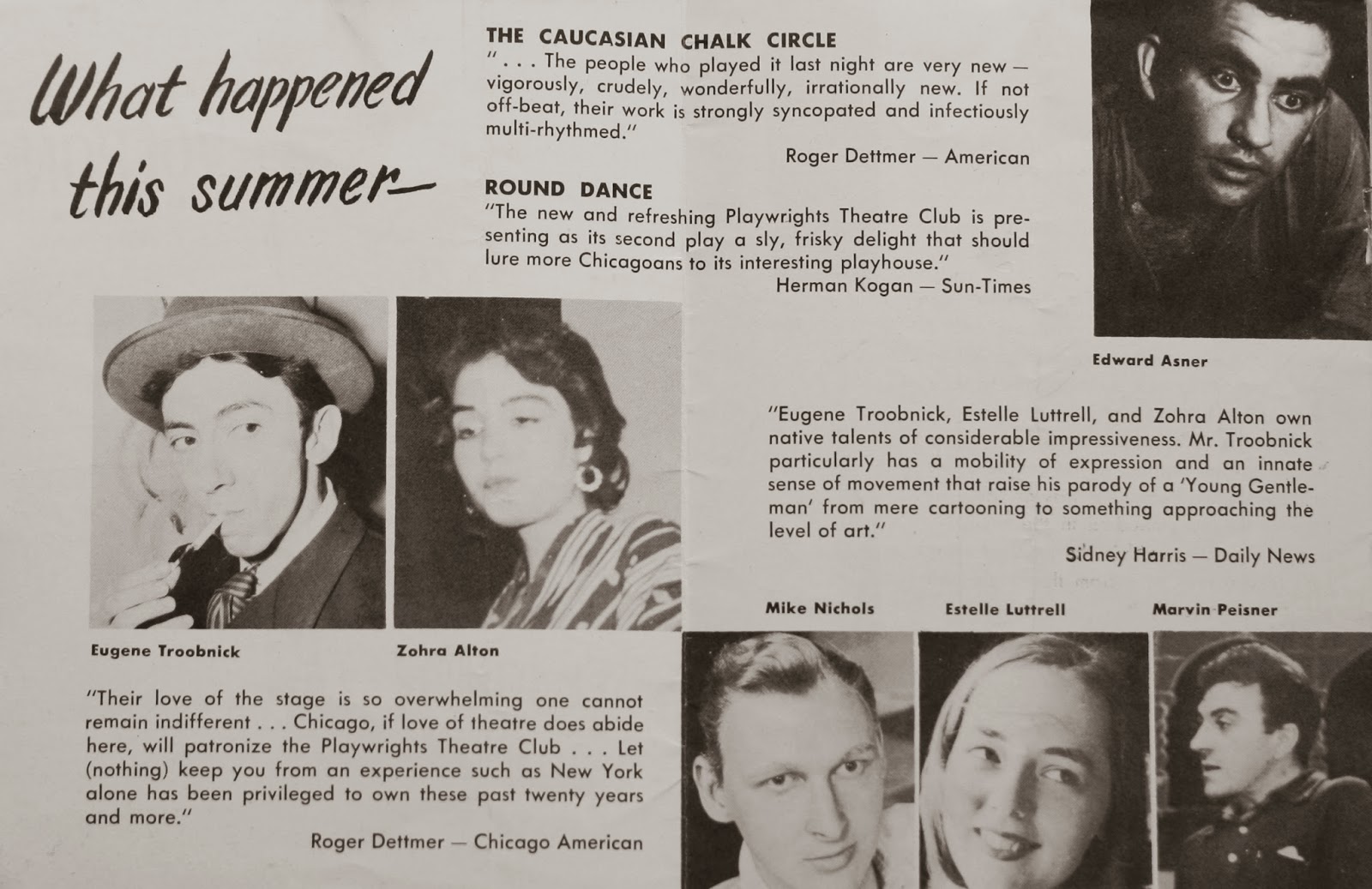
The curator of the Viola Spolin library exhibit at Northwestern University inquired if I was willing to clarify some photos and documents?  More than happy to.  A director from Second City in Chicago contacts me about submitting pictures for their upcoming celebration of the Playwrights Theatre Club. Done.  There is a Compass Improv Festival in St. Louis, Missouri.  Do I have shots from the original St. Louis Compass?  Sure do.

Playwrights Theatre Club brochure - 1953.
 

Jerry Stiller, Nancy Ponder & Alan Arkin at the St. Louis Compass, 1959.

These days, I’m trying to convince David Shepherd that a book of his vintage shots would be of enormous interest to the improv community.  Aside from the documentary, many have appeared in Jeffery Sweet’s Something Wonderful Right Away and Janet Coleman’s The Compass.  But believe me my improv brothers and sisters, there are scores of other pictures that have not been viewed by the public for many decades.  It’s time they found their way back into the light.


Michael Golding is a writer, director and improv teacher.  He can be contacted for workshops, festivals and private consultations at migaluch@yahoo.com. Michael participated in the evolution of the Improv Olympics & Canadian Improv Games. Artistic director of the Comic Strip Improv Group in New York & created the Insight Theatre Company for Planned Parenthood, Ottawa.  He is a faculty member at El Camino College in Los Angeles, working with at-risk teens and traditional students. His screenplay credits include "Celebrity Pet" for the Disney Channel and the documentary "David Shepherd: A Lifetime of Improvisational Theatre."  His book, Listen Harder, a collection of essays, curriculum and memorabilia on improvisation and educational theatre, is available on Amazon, Barnes & Noble and CreateSpace. Michael holds a BFA degree in Drama from New York University’s Tisch School of the Arts & an MA degree in Educational Theatre from NYU’s Steinhardt School of Culture, Education & Human Development.


Sunday, August 25, 2013

Diary of a Teen Improviser in the 70s by Michael Golding


December 2, 1977:  I am at the wheel of David Shepherd’s Chevy Nova, hurtling along upstate New York in the middle of the night.  David is beside me, asleep.  We’ve been invited to the premiere of the Canadian Improv Games (CIG) at a high school in Ottawa, Ontario.  The format is based on David’s Improv Olympics, and we’re both excited about how the Canadians will interpret his latest creation, which they’ve geared specifically for teenagers.

Suddenly, the car hits a patch of black ice and is sent spiraling out of control, spinning wildly until coming to an abrupt halt in a ditch.  I’m still gripping the steering wheel as a cloud of dirt envelops the car.  All I can hear is the sound of my rapid panting and pounding heart as I attempt to compose myself.  With his eyes still closed, David’s velvety voice breaks the silence: “You were driving too fast.”

It’s safe to say that some of my deepest, long lasting relationships are from the world of improv.  David Shepherd introduced me to this world at the age of fourteen, during the summer of 1972, when I was a regular caller on his improvised radio show, The Responsive Scene.  When the show ended, David invited me and my friends to participate in his new format, The Improv Olympics, which he created with Howard Jerome, one of the actors and host of the radio show.  Forming a team called “Fool’s Paradise,” we were the first teenage group to participate in the Improv Olympics at the Space for Innovative Development in Manhattan, December 1972.  Little did I realize that I was at the epicenter of something extraordinary, which would ripple out and influence future generations of professional and non-professional improvisers.

Fool's Paradise warming up for an Improv Olympics match.
David and I developed a mentor/protégé relationship, and he welcomed me into his home.  My formative years were spent around the founding members of Compass and Second City, (which included) Paul Sills, Del Close, Severn Darden, Barbara Harris, Mina Kolb, Marty Friedberg, Jerry Stiller, Ann Meara, Mark Gordon, Andrew Duncan and Omar Shapli.  At the time, I thought they were all cool adults who liked to play, not realizing their significance in the annals of improv history. 

Compass, with Andrew Duncan, Barbara Harris & David Shepherd, Chicago 1955.

By the time I was sixteen, I was a walking encyclopedia on everything Compass.  However, I regarded that knowledge akin to my father talking ad nauseam about growing up during the depression.  Did you know that during the seminal days of Compass, the shows were so bad that members of the cast would often jump into Lake Michigan after a performance to cleanse themselves of improv shame?  Cool piece of improv trivia, which tends to lose its luster after hearing about it for the two hundredth time.


Despite all the stories, Compass wasn’t real to me.  Aside from an audio recording, which was lost in a flood, some photos and posters, there was virtually no evidence of the existence of Compass.  Paul Sills often speculated that “one day some PhD candidate will write his thesis on Compass, which will get filed away and never read.”  Then, Jeffrey Sweet’s book, “Something Wonderful Right Away” came out.  Chapter after chapter, I discovered stories in print that I’d been hearing about for years.  Apparently, Compass really did happen and these eccentric adults in David’s living room weren’t making these tales up.


As I improvised my way through high school, the Improv Olympics was evolving at an exponential rate.  Howard and David had gone to Toronto with the format in 1974, where they participated in Homemade Theatre’s annual Improv Festival.  Before their eyes, Homemade Theatre overhauled the Olympics, making it more theatrical and sports-like, adding specific scoring guidelines and events, (such as Time Dash, Space Jump and Emotional Hurdles) with professional and non-professional leagues.

Homemade Theatre's Improv Olympics, Toronto 1974.


Howard returned to Toronto in 1975 for the festival, but without David Shepherd.  Instead, he brought Stage Fright, a high school team from Ottawa trained by Howard to participate in the non-professional league of the Improv Olympics.

Stage Fright takes the stage with Howard Jerome, 1975.

After graduating high school, Willie Wyllie and the other members of Stage Fright wanted to give something back to the community, and produced the first CIG in 1977. Created by Willie and Howard Jerome, the new format involved several Ottawa high schools. Approximately 450 miles away, I was a sophomore at New York University’s Tisch School of the Arts, blissfully unaware that improv was about to take an international hold on my life.

That year, David Shepherd and I traveled to Ottawa as guests of CIG, (despite my botched attempt to kill us on the road), where I met Stage Fright for the first time and developed an instant connection with Willie Wyllie.  As was the case with meeting David and Howard, this friendship changed the course of my life.  Aside from our common improv bond, Willie and I are also the same age, born days apart in the same month.  Willie is Howard Jerome’s protégé, and to this day, the two are still extremely close.  The improv quartet that is David, Howard, Michael and Willie was born.

Left to right; Michael Golding, Willie Wylllie, Howard Jerome & David Shepherd.


There were two differences I detected between Shepherd and Jerome’s Improv Olympics and Wyllie and Jerome’s CIG.  First, was in the amount of events.  Eleven in the Improv Olympics.  Six in CIG; Character Relay, Story Throw, Emotional Hurdles, Freestyle, Space Jump and Evolutionary Pentathlon, (which David called Time Dash in his format).

Secondly, while providing high quality training in the techniques of improv to high school students was the principal objective for CIG, providing an arena for them to develop their skills in problem solving, group creativity, and communication was just as important.  Those interpersonal skills had academic value as well as personal.  Grades increased and students, who had never considered university before, were now looking to continue their education beyond high school.  If all that wasn’t mind-blowing enough, the life-saving potential of the program became clear almost immediately.  Year after year, students would go up to Willie and Howard thanking them for CIG, followed by “I was in bad shape.  I was doing drugs.  I was cutting school.  I was irresponsible. I was making bad choices.  Then, I met my improv family……..”  Over the course of CIG’s history, thousands of young lives were saved by the healing power of improvisation.

A year after graduating New York University, 1981, I was working in Public Relations during the day and as the assistant technical director of an Off-Off-Broadway theatre at night.  Suddenly I was faced with two life changing choices from David Shepherd and Willie Wyllie:  Go with David Shepherd to Chicago, where he was going to simultaneously work on his play, the Jonah Complex and the Improv Olympics through his connection with Second City, or move to Ottawa and work on CIG and other projects for Stage Fright.

David Shepherd & The Jonah Complex.
Paul Sills was also encouraging me to accompany David, feeling that immersing myself in all Chicago had to offer would be beneficial to me as an improviser and workshop director.  How was I supposed to support myself?  “Sling hash,” was Paul’s response, “That’s where you’ll hear all the best stories.” 

Admittedly, I struggled with this decision.  Eventually, I decided it was time to forge an improv identity separate from David, so I choose Ottawa.  I don’t think David missed having me as his assistant in Chicago.  Shortly after I arrived in Ottawa, David met Charna Halpern through Jo Forsberg.  Charna and David worked on the Jonah Complex and the Improv Olympics together, which was very successful, with professional and community leagues and “identity teams” such as Freudian Slippers (a team of psychiatrists) and the God Squad (a team of Rabbis).

God Squad at the Chicago Improv Olympics, 1981.
Stage Fright smuggled me across the Canadian border, an operation that included no less than two attempted border crossings and an RCMP pursuit.  Apparently, when you show up with a thousand dollars in cash, a ton of luggage and no return date, people get suspicious.  Stage Fright put me immediately to work on CIG.  Getting up at the crack of dawn, Willie and I would grab breakfast at a McDonald’s drive-through, then spend the day hitting high school after high school where I conducted workshops, refereed matches, acted as a judge and participated in planning sessions in the evening with the high school drama teachers.

 Playbill from 3rd annual tournament.
After living in Ottawa for two years, I decided to return to New York in 1983, the same year Shepherd returned from Chicago, where the Improv Olympics, now helmed by Charna Halpern and Del Close, morphed into iO. 
Charna Halpern & Del Close @ iO Chicago

 
By this time, CIG was spreading to more high schools in Ottawa.  Through-out the eighties and early nineties, I returned to Ottawa several times a year to conduct workshops for CIG and occasionally guest as a judge.  As the expansion of the program included more high schools, the rules were modified to reduce the school vs. school competition.  This was done by requiring students to perform with peers from other schools.  The Great Canadian Theatre Company allowed Stage Fright to use their facilities for CIG’s matches, although one year the students had to perform on a stage with an Elizabethan set, and the National Arts Centre became a supporter as the program began to expand into neighboring cities.

National Arts Centre
In 1992, shortly after moving to Los Angeles, I sold a screenplay to Disney, which was never made, and for the next ten years had my spirit slowly obliterated by the Hollywood dream factory.  It’s everything you’ve read about, and more.  Ten years later, 2002, it was the 25th anniversary of the Canadian Improv Games.  Willie Wyllie got me there the way he knows best, through guilt.  “Michael, David and Howard are going to be there. You have to be there. You’ll regret it if you don’t.  It’s going to be historic.”  What made me finally book my flight was Willie’s assurance that this was probably going to be the last year for CIG.  It was time to give the program a decent Viking funeral.  Then again, I was told the same thing by Willie for the fifth, tenth and fifteenth anniversary as well.  By CIG's good fortune, something always came through at zero hour, providing the program with renewed life. 

Maxing out my VISA card, I made it to the anniversary.  It was the first time David Shepherd, Howard Jerome, Willie Wyllie and I were together in the same time zone in ten years.  It was wondrous and overwhelming.  CIG was now nation-wide, encompassing 300 high schools and over 3,000 students.  Gone was mixing students up from various schools into teams, each school had their own specific team.  The events were overhauled as well, simplifying the rules and making the structures less complex.  The events were cut down to five, emphasizing specific arts skills: Life, Theme, Style, Story and Character.  The National Arts Centre was now a full sponsor and the location for the annual national tournament.

But, what stood out to me the most was that CIG now had a specific style.  There were up to eight players on each team, and the scenes now took on a Harold-like mosaic.  The entire team performs in each event, and in four minutes, two person scenes, monologues, group song, dance and activity spring out in a burst of energy after a 15 second huddle to determine the plan of action from an audience suggestion.  It was thrilling to watch as an immediate problem was being solved on the spot.

Canadian Improv Games National Festival at the NationalArts Centre, Ottawa.
It wasn’t difficult to ascertain how this new style came about.  The sensibilities, humor and intelligence of the artistic director at the time, Alistair Cook, infected his staff like an improv virus, which in turn spread to the teenage players.  The man had a clear vision, and engendered a level of loyalty from his staff that I’ve rarely encountered in the theatre world.

The referee and lines-men, who gather suggestions from the audience, was now a vaudeville-like show unto itself during the tournament.  Dave Morris set the referee mold – affable, engaging, knowledgeable and able to switch seamlessly into disciplinarian mode and back without any pretense or guile when the audience occasionally became rowdy.  His legacy was immortalized in the film “In The Moment,” a documentary about CIG directed by alumni Sandra Chwialkowska.

The high point of the 25th anniversary was a midnight workshop for the trainers, conducted by me, Howard and David.  We each took a half hour portion.  A few hours later, we retreated to David’s room and improvised together until dawn.  This has since become our usual evening ritual at the national festival.  Whenever all three of us attend the games, we retreat to one of our rooms after the show, and play until we can barely stay awake.

Fast forward ten years, April 3rd – 8th, 2012 to be exact.  Once again I’m in Ottawa for the CIG Nationals with another milestone to commemorate – thirty five years!  There’s a distinctly different innovative vibe to the festival, which I attribute to Al Connors, the new artistic director and president of the games.  The week long workshop schedule is more diverse, covering story, character, script writing, long form, status, monologues, environment and the importance of silence, something novice improvisers traditionally shy away from.  I was proud to conduct the first coaches’ workshop, sharing my educational theatre experience with teachers from all across Canada and assisting Howard Jerome in presenting Life-Play, David Shepherd’s latest creation where people improvise together on the phone.

 Howard Jerome administers the CIG oath.


At the shows, teams were pushing themselves further, exploring diverse styles ranging from clowning to melodrama.  The emotional impact of issues relevant to teenagers resonated with the audience through the power of long pauses.  In his second year as head referee, Chris Ramelan is immensely likable on stage, projecting an aura of innocence that often belies his devilish sense of humor which hits the audience with very little warning.

Over the past decade CIG has brought me out to the national festival many times to conduct workshops and moderate forums.  In 2009, I was given the honorary title of “CIG Ambassador to the USA,” which came with a sash and personal request from Briana Rayner, the administrative director of CIG.  Wear the sash through customs.  I have yet to honor this request and I sense Briana’s patience is waning. 

The Ambassador receives his first CIG salute.

Later that year, Willie Wyllie and CIG financed a documentary about David Shepherd, directed by Mike Fly, an alumnus of CIG, and written by me.  Willie wanted there to be a concrete record of all of David’s formats and for everyone involved with CIG, past, present and future, to know that they are all part of David’s legacy.  As of 2011, Willie made "David Shepherd: A Lifetime of Improvisational Theatre" available on YouTube for the entire improv community to enjoy, free of charge.

Canadian Improv Games takes over Parliament
 
It’s ironic that in a season where CIG lost a third of their budget due to a shift in philanthropic focus from one of their sponsors, everyone involved, be they staff, volunteers, students, coaches or teachers, were more optimistic about the continuation of the program than ever before.  You can’t stop the Canadian Improv Games.  In the words of Briana Rayner, “This year was simply magic.”  I couldn’t agree more, although I did forget to bring my sash for the 35th anniversary.  I need to take my role as CIG Ambassador to the USA a lot more seriously.

 
And scene!


Michael Golding is a writer, director and improv teacher.  He can be contacted for workshops, festivals and private consultations at migaluch@yahoo.com. Michael participated in the evolution of the Improv Olympics & Canadian Improv Games. Artistic director of the Comic Strip Improv Group in N.Y. & created the Insight Theatre Company for Planned Parenthood, Ottawa.  He is a faculty member at El Camino College in Los Angeles, working with at-risk teens and traditional students. He wrote and co-produced the documentary "David Shepherd: A Lifetime of Improvisational Theatre" (available for free on YouTube).  His book, Listen Harder, a collection of essays, curriculum and memorabilia on improvisation and educational theatre, is available on Amazon, Barnes & Noble and CreateSpace. Michael holds a BFA degree in Drama from New York University’s Tisch School of the Arts & an MA degree in Educational Theatre from NYU’s Steinhardt School of Culture, Education & Human Development.