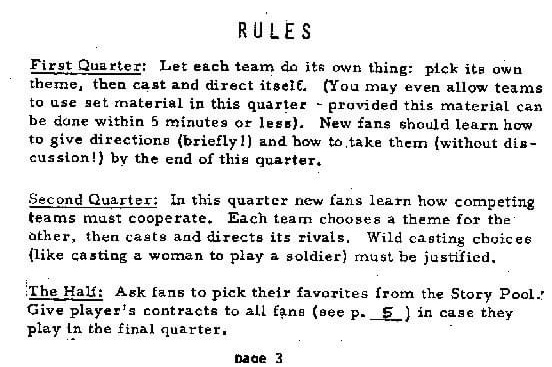
In 2007, David Shepherd's cousin suggested he write up the three most important programs of his life. First one David tackled, was the Improv Olympix (originally called the Improv Olympics, before the Olympic Committee threatened a lawsuit), which David co-created with Howard Jerome. David never got around to writing up the other two programs, having been sidetracked by the creation of a new format in 2008; Life-Play, improv games designed to be played over the phone. I recently found David's chapter on the Improv Olympix and it's a fascinating piece of history from his perspective.
IMPROV OLYMPIX HISTORY BY DAVID SHEPHERD
Beginning in the 1970’s theatre saw a raft of innovations. In Chicago, Del Close introduced his “Harold” format, for instance, by which a small group creates a coherent piece
of 30-40 minutes from one audience suggestion; themes, characters and
locations are positioned in improvs for two players or the whole group. In
Calgary, Keith Johnstone introduced Theatre Sports, a collection for two
teams of over 50 games, which is now franchised across the world. The first of these new structures was invented in New York City—the Improv Olympix; family and friends have asked me to describe its origins from memory.
In 1969 my ten-year marriage to Honey Stern unraveled abruptly in NYC. I moved to 13 W. 89 St: a big second-story room, which I believed would pass for an office. It
was purposefully close to my kids, who visited and played under a
wooden door that I fitted flat against one corner and draped with
curtains to hide the fact that it was full of blocks, crayons, trucks and other toys.
Here I committed myself to what my father would call a “do good” role: to identify root causes of group friction, malfunction and conflict. I would summon communication and productivity. I would be a community “maker.” Such ideals had considerable currency in the 60’s and had already won me two jobs at NJ Community Action and at Scientific Resources Institute. Community was graced by billions from Kennedy. Under his handsome umbrella I would locate clients and supply training and public relations—delivered by a powerful phalanx of Community Makers. Thousands of consultants were similarly busy.
“Commerce Business Daily”--plump with listings like “deliver 1000 rats to Lab X by Mar. 1--” provided me with my first example of what a Community Maker will do: for instance, he or she will travel to a high-rise in St. Louis. Find out why elevators that stop every other floor to serve small, decaying apartments, somehow attract violence and social despair (have done so for years.) You will then design ways to cure the malaise, staff your proposal, get it approved, tool up and go to work. In
actuality, after years of tinkering, the city declined all bids, moved
all tenants out to smaller buildings in other areas, and simply blew the
buildings up. By “imploded” demolition.
One
of the first to enroll in my tiny army was Howard Jerome Gomberg—ex
football player, wrestler and tab-musical performer, who called himself
Jerome. (I insisted on calling him Gomberg, showing my prejudice for reality and contempt for self-regard.) Howard quickly ingested my ambitions.
 |
| Howard Jerome |
Encouraged
by other idealists, we decided that a more likely target for our
reforms was theatre, which we saw, long after the advent of improv, as
mired still in egotism--stardom. Each actor acted in his or her own shell, while the dynamic of each performance was limited to the verbal pyrotechnics of the playwright. A play was more a chess game than an occasion to celebrate human emotions and interactions. Most scripts bored us.
In our plan the playwright would be replaced by the audience, which knows exactly what it wants and supplies ample ideas for content. Tonight’s audience knows better than any playwright exactly what will satisfy it tonight. Treat the stage like a sports arena. Actors become players. Action becomes team play. Who wins (and how) becomes more absorbing than the often abstruse point of a play written at another time far away from the audience in these seats.
For a base structure use games, of which there are hundreds floating around. But for our sport use only games that give players exposure to the basics of theatre. Give actors a keener experience in acting than most scripts can. Immerse them in skills, for instance:
character observed clearly--on the spot
deep, transforming emotion
relationship dependent in no way on words
creation of objects by pantomime only
close relationship through gibberish
improvising a song
improvising a story
improvising through slices of time
improvising in different locations at the same time
treating a subject with maximum negative or positive
feeling.
We called our sport the “Improvisational Olympic" and later (since the Olympic Committee objected) the “Improv Olympix,” when we began video coverage.
With Howard on board, I changed our name from Community Makers to the less ambitious Group Creativity. After all, group creativity had inspired COMPASS--with its strolling audience, improvising cast, creative spectators and a network of neighbors writing scenarios. We moved from our remote Upper West Side location to a large building near Madison Square Garden—the Space for Innovative Development. Here we were within reach of national dance companies and adventurous groups like ourselves. Here we could rent space in which to perform. It was 1973.
 |
| The Space for Innovative Development |
The first teams were composed of staff and old friends. “Jerome’s Bombers” played “Running Bare,” which included Janet Coleman, author of “The Compass,” and David Dozer. The match was reviewed in the press. The college aged sons of a consultant for whom I shot video offered to play. We discovered that, depending on life experience and willingness to risk, a new team could be launched in hours. A correctional facility in Westchester sent a half dozen men plus guards, who were received at the door by Sydney Johnson. She
asked, “Do you want to play, boys?” and took them through training
enough to perform a scene I will never forget: inmates in a cell where a
vial of heroin has just be spilled by mistake on the floor. They
invested it with humor but also, surprisingly, with pain.
 |
| Jerome's Bombers |
I formed a Soul team, whose intention was to play big and hard as possible--but lose. Soul’s job was to model the games and show how accessible they were. We drew strangers to take a chance, do the training, enter the league and win.
One afternoon we were visited by a thin, nervous teenager
from Queens—Michael Golding. He was participating weekly in Responsive
Scene, our improv radio show over WRVR, where 35,000 listeners could
phone in suggestions, stay on line, direct action and even improvise
with the cast. Michael had had the nerve to record his own
improv bits with his own friends and squeeze his tape onto the air via
phone calls he made to the station.
We saw Michael was a candidate for the Olympix. I immediately offered to play whatever group he came up with. Soul
met his team in somebody’s home (so we wouldn’t have to pay rent for
space). The location was frumpy: sofa, stuffed chairs, carpets. No matter. Soul warmed up casually until we noticed Michael’s group was intense. An anomaly: I was developing a new sport that might one day contribute to my income, but I was laid back. Michael was one of a vast, to me colorless, lax population that many adults write off as disinterested in culture. But he was up tight!
 |
| Michael Golding (LR) and his team Fool's Paradise |
Every “event” his teens attempted was a see-saw challenge for them. Every time they lost their confidence crumpled. If they won, their triumph galvanized them for the next event. Essentially the match was Fun
for us but Life for them. I saw that Soul could no longer play to lose,
but as our concentration and energy picked up, so did Michael’s.
We lost! I was flabbergasted, limp, crawling with uncomfortable surprise. Michael’s
team leapt directly into a sports cliché. They crowed, they spurted
energy, they slapped five and clapped each other on the back, they ran
around the room. Some jumped on the couch, then mocked our adult superiority and summoned a phony sympathy for us losers. Still
there was more to come: they went over details from their training,
their minute-to-minute expectations, the match itself—event by event. Where they had lagged, where they’d surged ahead. At that embarrassing moment I realized: we had made converts. We had in fact invented a sport.
1974: we were invited to Toronto by Howard’s friends at HomeMade Theater. A half dozen Canadian directors were invited to sit in on a trial match. These men and women quarreled for two hours, questioning the names we’d assigned each event, rules of play, standards for judging, number of players. For instance, could two or more players from one team play two or more from another? What emerged was tighter, more competitive—with a Canadian sparkle and practicality.
 |
| HomeMade Theatre |
Home Made Theater promptly combed Ontario for teams and found about 8 groups willing to play into a tournament. I was astonished at their diversity. On
one hand was the national theatre school, composed of affluent giants
who treated the Olympix as they would life after graduation: it was something to overcome, to
win--from finding lodging to locating auditions, from making friends of
agents to winning jobs in all media. Their play was boisterous.
On the other hand was a team of Mummers, who circle Lake Huron by whatever transportation they can find, inquiring as they go if some family would like a show mounted in their living room or barn. They
adapt what they carry in their back packs to the tastes of the
family—much like the players that Hamlet uses to “catch the conscience
of a king.” Where do they eat and sleep? with the family for which they play, so their material better not disappoint.
That summer Howard and I were hired to behave like Mummers in the northern ski area—with amateur ski workers willing to face rough competition, at a Lions Club gala, from dentist teams we trained. The event I remember best was a match between 16 year olds who welcomed interruptions during training at their posh club and 13 year olds who met in a meager barn and paid attention--for days. Much to the surprise of the swank team the younger set won easily. The match revealed social status—upset.
Next came the search—city by city-- for funds to pay for the sustenance of a program whose participants could claim it produced value: it generated skills, brought isolated people together, fostered teamwork. It was also cheap, fun, easy to mount, psychologically rewarding and attractive to many ages.
First came New York City, where we had already identified and pursued a dozen foundations--without success. Now we broached the school system and were invited to the Bronx. On my first visit I arrived 8am at a school where the teacher had not yet arrived.
I approached a group of students, told them what I had for them and got them playing. By the time the teacher started looking for me, she found her kids in full swing. Eventually 11 schools joined the Bronx league, which was run by a student of Paul Sills—Paul Lazar. Every year there was intense competition; every year the same school won.
I remember a match at which not enough students showed to form one team: our bottom line was 5, but only two boys were present. I broke my rule and allowed them to play. One of our judges, Daren Daly, had traveled miles on his red motor bike to attend; he was dubious. But
surprisingly the team of two managed to pull off all ten events ,
adapting suggestions to avoid the void of mothers, for instance, or
sisters. Daren and I were amazed. Their handicap had given the two double zest, imagination and confidence. In comparison the big team they played looked limp.
Dealing with the Bronx Board was tough. It didn’t want to pay Group Creativity the small salaries allotted for coaching. Eleven coaches got paid, but I got almost nothing of their checks. I couldn’t invest more of my own money in phone, mail, transportation, props, xerox, photos. I gave up N.Y.C.
Next: Chicago, where I visited for several months in 1981. Jo Forsberg let me teach at her theater school, where a new student, Charna Halpern, implored me to give her a scholarship. Charna had been teaching disadvantaged girls and felt improv offered no terrors more difficult to cope with. In the first weeks of our association, I sensed she was going to take over any Chicago program that came to life. The first teams played on a spectacular all-metal floor in a local bar. “The
Reader” gave us great press, and soon we had six volunteer coaches to
train all the teams that wanted to enter a Chicago league.
 |
| David Shepherd and Charna Halpern |
Training was often done in six hours—on six packs, in basements. We
started to get what we called “affinity” teams--professional actors,
seniors, cops, rabbis, psychiatrists, musicians, lawyers, an all women’s
team. It seemed word of mouth was by lightning. When I visited New York, I heard at parties that this great game was embracing the Mid-West. When in Chicago, the thing to do was Improv Olympix.
We played Cook County jail, where men were dumbfounded to discover that there was something they could excel at: an improv match against a middle-class team with white women on it. This is where Charna first tried out her way of announcing scores. She
announces the loser and point number first, giving that team the hope
that they won, and then the winner with a greater point number. However
the jail had no money for a permanent program giving inmates the
experience of winning.
Next I took on the Chicago school system, but I didn’t have the right connections. I ran into the same attitude that I found in most NYC boros: the schools know what you have and don’t want it. The schools know that your program will not succeed. The schools are sure that your design is wrong for their classes and your curriculum is inadequate, so please don’t send it. I didn’t have the razzle-dazzle video that Canada was about to produce.
One
night on Amtrak, passing the jail with a match in progress, on my way
home to my wife Connie and my kids in NYC, I was gripped by sadness. I
was slowly realizing that my best designs for improv formats were never
going to earn me much cash, and that I was going to have to support my
family on money earned in sales, copy writing, PR, children’s books,
personnel, administration—not to mention a few other gigs too demeaning
to mention.
Of
course, if Lazar and Halpern and Howard and Willie were willing to
write proposals not for the Olympix but for autistic children or
unemployed girls at risk or psychiatric patients, if we could afford to turn out a dozen grant applications a year, one of us might have scored. Once at least. We might have proved that the Olympix just happened to be the ideal way to benefit this or that population. If I had to do it again?
The end of the Chicago story is revealing. We’d played Second City, where Joyce Sloane allowed our annual tournament to take place Monday nights at her main stage. We’d played a downtown bank auditorium during a festival in the Loop. We’d acquired great press--due often to our photographer, Virgil Shrock, who captured any match we sent him to any time of day or night.
Thousands had enjoyed watching our format or playing into it. National tournaments had brought teams to Chicago or NYC. But Charna was not making a living. Unlike the Canadians she complained our games demanded too much competition, which made them less commercial. She and the late Del Close closed shop and went up the street to Wrigley Park, There they founded a training program for comedians. Not satisfied with this, they opened a branch in L.A. Both pack customers in much of the week.
 |
| Del Close and Charna Halpern |
In 1984 the International Olympic was held in LA. I decided to attend. I’d present our new format at a public location. The timing was perfect. Competition in performance would meld with competition in sports. My trip began with a triumph: I got permission to use Santa Monica pier, which was thick with strollers and customers every weekend. Ads and flyers were picked up smartly by the press, and I was welcomed by a large improv community that knew who I was. What did I imagine would happen if I appealed to the city for as many teams as I could imagine—each speaking its own tongue? I suspected we could reveal a rich cultural mix that was not possible on track, high board or wrestling mat.
I arranged to meet a real Russian restaurant owner and get him to allow my brand new Russian assistant to train Russians to improvise. Carefully I prepared him by speaking of the magic of improv, the discoveries it made possible, its delightful evanescence, the comic undercurrents in any dramatic situation, the characters uncovered by improv, its commercial acceptance on TV. I promised to bring matches onto his stage.
He smiled. He understood? He paused. He considered what to say. Then he started to sing. His his eyes shone but his voice was lead.
I didn’t get his meaning. Could he be making ponderous love to a style, a carefully crafted anthem, a musical masterpiece that had exemplified Russian art for centuries? Was he saying, "Improvisation cannot equal this solidity. Improvisation is for performers who can’t feel this surge of belief. Improvisation cannot exist in the Russian heartland.”
But suppose he had said “yes.” Suppose a dozen cultural groups
asked to be trained. Where were the Chicago coaches that would
appear magically in basements bearing the six-packs that
guarantee a team is formed in six hours?
Would the team perform in English? If not, where would I find
judges who understood the languages used by both teams playing?
Who would have trained the Mexican team, the French team, the Indian,
Iraqi, Tibetan, Ethiopian, Brazilian, Serbian....teams? What criteria
would I use to judge when a team was ready to compete? All such considerations were swept aside by my mania. And mania is a welcome state of being in the tinsel and celluloid corridors of LA.
I remember--in a bout of loneliness--phoning the Coach of the Chicago police team “Magnum Farce” to get phone numbers of his cast, then inviting them all to fly to LA and appear on the Santa Monica stage. Leave their jobs for lodgings I would be paying for at a salary unknown. I wanted them because they had come in second twice at annual tournaments. They had improvised my favorite Time Dash to the theme of “filing:” in the first frame a group of officers belittle an unpleasant know-it-all. In the second this same incompetent is handing out orders that irritate them. In the last frame the nebbish has graduated to Head of the Department, and (still filing) his former critics are all in fear of him.
Magnum Farce stayed in Chicago; policemen are seldom manic.
I did run workshops, train teams, set up performance schedules.
Sensing overload, I did ask Howard to come assist. He arrived
promptly after my phone call. I did find video coverage. More and more local people became involved, until I was overwhelmed by detail: presentation, sales, training, PR, organization. My program appeared to be successful, and success was killing me. The best thing that could happen to me would be the end, toward which I improvised as I went along.
My best memory: two German tourists were given Silent Wrestling to play. They improvised a vast silence between “Der auto ist kaput” and “Ach, mein Gott.” Effortless. Effortlessly Canada won the competition. Something else happened in LA. Howard discovered an electronic link between 3
widely separated stages, where it was possible for three teams to
improvise simultaneously in what I remember was called a “slow scan;” the listener heard only a portion of what was broadcast. Ingenious. Futuristic. Suggestive of future technologies. But a reason to visit LA?
The Canadian Olympic Games (CIG) started in New York. Chicago City Limits, located far west on 42nd St, invited us to hold international matches on their stage. Only Canada and the USA were involved. Ottawa high school students were guided by Willie Wyllie, who later ran the Stage Fright team. The Canadian kids spent the night of the match at the home of Barbara Caporale’s parents, where there was just enough rug and sofa room to accommodate 20 boys and girls. We all discovered that their experience of travel, comradeship and performance was intoxicating. These elements propel CIG to this day.
 |
| Michael Golding, referee of teenage match at Chicago City Limits, with Willie Wyllie |
|
|
|
 |
| Canadian teenagers with Chicago City Limits cast |
 |
| Stage Fright, producers of the Canadian Improv Games, Willie Wyllie, center. |
Willie asked me to give him rights to the games. I demanded a percentage of his gross as royalties, which he said would be nil (he was right). We dickered and eventually I avoided a nasty falling out by my giving in. Since then he’s been immoderately generous, inviting me, Golding and Jerome to many Ottawa anniversaries.
On my 80th birthday, as I peered out of the window of my office near Amherst, I spied what appeared to be Willie. “Must be someone who looks like him,” I rationalized, “since the real Willie is in Ottawa. I came to the same conclusion with Golding: “he’s in L.A.” But Willie, Golding and Howard were all three really in my backyard. They played into an impromptu show for my guests, and we spent half the night catching up.
 |
| Michael Golding, Willie Wyllie, Howard Jerome, David Shepherd |
 |
| David Shepherd's 80th birthday party |
Today in Canada 300 high school teams start matches by chanting an oath originally inspired by Howard:
We have come together
in the spirit of loving competition
to celebrate the (CIG or Improv Olympix).
We promise to uphold the ideals of improvisation:
to cooperate with one another,
to learn from each other,
to commit ourselves to the moment
and above all....
to have a good time.
The CIG does not celebrate and exercise 10 theatrical skills. But it gives thousands of kids an alternative to the dreary monotony and isolation they may experience in high school. Self-esteem
(and often lives) have been saved by the CIG, which has endured only
because thousands of young Canadians have learned over decades how to
manage. For instance, they have cut the games down to 5. In their words:
Character Event portrays characteristics such as flamboyant or bashful,
Life Event shows an event perceived to be pivotal--with sincere and realistic emotion,
Story conveys a story with beginning, middle and end,
Style projects a style of film, literature, etc., such as children’s book or film noire,
Theme explores an aspect of a given topic such as “communication” or “choices.”
There are a dozen regional tournaments, with winners traveling to Ottawa for annual finals. Improvisation has truly demanded to be treated as a sport. Teams are now allowed to enter CIG by shooting video of their play and sending it to be judged.
What I enjoy most about CIG are, first, their warmups, which are held in one room. Open the door and you are assaulted by many energies in boisterous tumult. You may predict the approach of each team to the games. Later when they play you notice how their warmup prepared each for competition. It’s a miracle to see teams suddenly achieve the seamless interaction of its players.
Second I enjoy the dead eye concentration of the coaches who serve as judges. They take themselves very seriously because they may have coached one of the teams on stage. Some coach dozens of teams in one region, such as Toronto—often with no compensation: a national program based solidly on love and commitment!
In the future we’ll see CIG branch into other countries—including the USA. We can expect more matches on TV and maybe more participation by younger children and adults. After all, there is nothing about the Olympix that restricts it to a teen activity.
Michael Golding is a writer, director and improv
teacher. He can be contacted for
workshops, festivals and private consultations at migaluch@yahoo.com. Michael participated in the evolution of the
Improv Olympics & Canadian Improv Games. Artistic director of the Comic
Strip Improv Group in N.Y. & created the Insight Theatre Company for
Planned Parenthood, Ottawa. He is a faculty member at El Camino College
in Los Angeles,
working with at-risk teens and traditional students. He wrote and co-produced
the documentary "David Shepherd: A Lifetime of Improvisational
Theatre" (available for free on YouTube).
His book, Listen Harder, a collection of essays, curriculum and
memorabilia on improvisation and educational theatre, is available on Amazon,
Barnes & Noble and CreateSpace. Michael holds a BFA degree in Drama from
New York University’s Tisch School of the Arts & an MA degree in
Educational Theatre from NYU’s Steinhardt School of Culture, Education &
Human Development.